

My Duel withdrawal history
Karssen's player notes · Author's choice
Duel is my pick when I want to get straight into an Original and let the rewards run in the background. I like its direct, game-first feel. My USDT withdrawal history gives that opinion a useful companion: actual account rows marked Complete.
I come here for a session, rather than a welcome-package calculation. Duel's appeal makes more sense once you put the games first and treat rakeback as a small return on play you already wanted to make.
 Karssen AvelarPlayer and editor
A typical Duel visit starts with an Original. I choose the game, open its rules and settle on a stake before I look at the reward progress. It is a small habit, but it stops the evening becoming a tour of whatever badge happens to be flashing in the lobby.
What I enjoy is the lack of ceremony between arriving and playing. The game controls and wallet are close to the part of the screen I actually use. If I want a short session, Duel feels easier to keep on that track than a lobby asking me to juggle several deposit offers.
I still give the game's rules a proper look. An RTP headline does not tell me the payout for the setting I have selected, the size of a losing run or whether that title earns the reward I am looking at. The house edge explanation helps with the arithmetic; the particular game's information decides the rest.
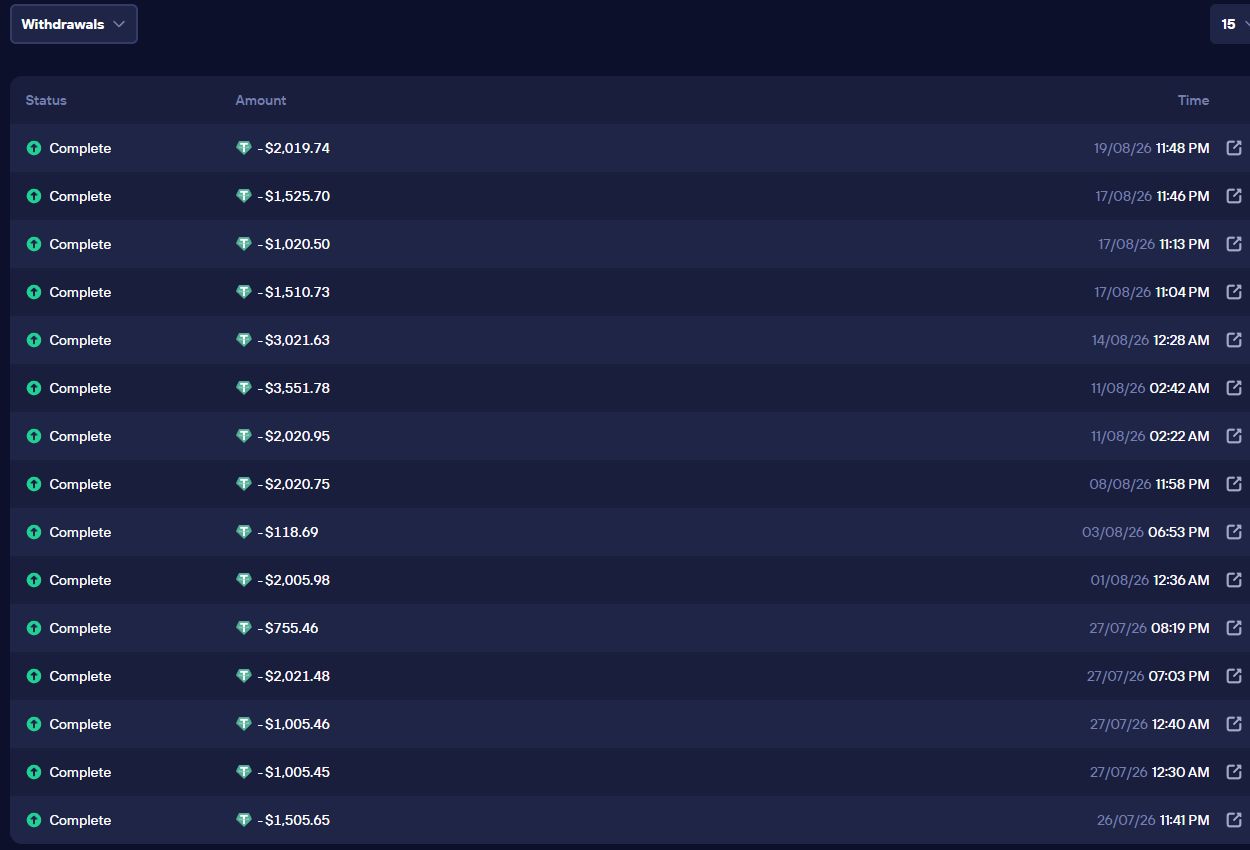
This is the withdrawal list I kept from my Duel account. It includes a $2,019.74 entry on 19 August 2026 and a $3,551.78 entry on 11 August 2026, each marked Complete.
The repeated Complete statuses are a reason I am comfortable putting Duel high in my own selection. There is a difference between showing a room I have opened and showing its transaction list. The history gives you the latter, across July and August, rather than a single carefully chosen line.
It is still a withdrawal list. It does not show my deposits, the stakes behind those balances or my overall result. Adding the amounts and calling the total profit would be nonsense. The rows also do not pair a request time with the time my external wallet received the funds.
For a new USDT withdrawal, I want the receiving wallet's network to match the network offered in Duel. If a transfer is delayed, I check whether the request is still in the casino account or whether a transaction hash has been issued. Those two states call for different questions; the crypto withdrawal guide shows how to separate them.
Duel uses recurring rakeback instead of a conventional welcome deposit bonus. The base rate is 2% of the game's house edge, with higher levels reaching up to 50% for qualifying Originals. The important words are 'of the house edge'. They keep an attractive percentage from becoming a fantasy refund on everything you wager.
The model uses Base Edge = 100% minus RTP. A game with a 0.1% edge has a theoretical casino share of $1 for each $1,000 wagered. A 2% return on that share is $0.02; at 50%, it is $0.50. This is an arithmetic illustration of the base, not a claim that every Duel game has that edge or that those stakes produce a predictable loss.
I would take the reward on a game I already like. I would not switch to a worse game or extend a session merely to move up a level. A higher rakeback percentage can look dramatic while returning very little cash when the underlying edge is small.
| Item | Duel's model | My decision |
|---|---|---|
| Welcome offer | No conventional deposit welcome bonus | Choose it for the games and recurring rakeback |
| Funding | Cryptocurrency; no fixed casino minimum in the stated model | Allow for the chosen network's transfer cost and requirements |
| Rakeback | 2% of edge at the base; up to 50% at top levels for qualifying Originals | Judge cash value at the actual game and account level |
| Identity checks | Duel may request KYC before processing a withdrawal | Keep a larger cashout separate from money needed immediately |
| Transaction charges | Duel says it does not profit from deposit or withdrawal fees; third parties may charge | Read the final amount and network cost before confirming |
BTC, ETH, USDT, USDC and SOL are among the listed crypto options. A coin name alone does not identify a transfer network.
First, when the withdrawal screen opens. Duel can request identity verification before processing the payment, even if earlier play felt straightforward. I keep the request intact while dealing with that check. Cancelling it to play the balance again would turn a paperwork question into another session.
Second, when I review the transfer amount. A casino taking no profit from fees does not make a network transfer free. I compare what leaves the account with the amount the receiving wallet is expected to get, then keep the transaction reference. If I need help, that gives me a specific payment to ask about, rather than a vague 'where is my money?' message.
Country eligibility belongs before either step. Duel excludes a number of markets, including the United States, United Kingdom, Germany, France and the Netherlands. I would not treat an accessible lobby or an existing account as permission to play from a restricted location.
Duel is one of my first choices for a direct route to the game and a reward model that sits behind it.
Duel's model gives you recurring rakeback. If a welcome package is the deciding factor, compare the actual offers in Author's choice first.
Compare Author's choiceMy completed USDT rows are useful history. They support a personal account record, without making a deadline for your next withdrawal.
Duel's model has no conventional deposit welcome bonus, and there is no promo code attached here. It uses recurring edge-based rakeback instead.
The approximate crypto payout expectation is about five minutes, with possible identity, processing or network delays. My screenshot shows completed account entries, rather than a measured request-to-wallet duration. I would not use five minutes as a guaranteed deadline.
Yes. Duel reserves the right to request identity verification before processing a withdrawal. Starting a session without a document prompt does not remove that condition.
No. The percentage applies to the house-edge base, and the upper rate belongs to top levels for qualifying Originals. The reward can be a small cash amount even when its percentage sounds large.
Duel stays near the front of my selection because I like the route into its games and can show a meaningful USDT account history alongside that preference. Its reward model suits the player who arrives with a game in mind. If that sounds like your evening, the Originals are the reason to open it.
A broader crypto casino and VIP experience
Separate the headline percentage from the cash amount
Compare personal picks with attributed community reports
Overall editorial score8.6 / 10
I put Duel high in my selection for a focused Originals session. It gets me into the game without a deposit-package puzzle, and recurring rakeback fits play I already wanted. If you are comfortable funding by crypto and handling a possible identity check, this is a strong place to start.
My editorial judgment from the experience and conditions described above, not player votes or measured payout performance.
The game controls and wallet stay close to the part of the screen I use. I like the direct route into a short session.
Edge-based rakeback can follow a game I already enjoy. Its cash value needs the actual edge and account level, even when the headline percentage looks large.
My repeated Complete USDT entries give me confidence in keeping the account. That personal history is useful context, without establishing profit or elapsed payout speed.
Crypto funding suits my use of Duel. Matching the transfer network, allowing for third-party costs and a possible identity request asks more of a newcomer.