
Glossary entry 4 min read · May 2026

Casino VIP Traps 2026 - Verified $700 Deficit Math

See honest casino VIP traps: verified $700 deficit math tested in 2026, silver-to-gold example, expert tier ladder analysis, opt-out advice.

Casino Feedback explainer on vip traps

Casino VIP traps are the structural patterns inside a VIP loyalty programme that turn a tier upgrade into a net loss for the player. The marketing presents VIP as a benefit. The math, calculated plainly, often shows the VIP "perks" cost more in incremental wagering than they return in incremental rebates. This entry on Casino Feedback walks the trap mechanics, computes a real $700 deficit example on a silver-to-gold promotion, and shows how VIP traps fit onto the six-axis editorial scorecard.

Snapshot. Casino VIP traps include hidden wagering volume requirements to maintain tier, sticky tier-only bonuses that strip at withdrawal, opaque retention promotions targeted at high-volume players, and tier-reset mechanics that force constant wagering to avoid demotion. On a typical silver-to-gold promotion across the brands on my feedbacks index, the incremental volume to maintain gold tier produces approximately $700 of expected loss above what the incremental rakeback returns. The trap is mathematical, not behavioural; the marketing hides the volume requirement, not the player who falls for it.

What casino VIP traps actually are

A casino VIP programme is a tiered loyalty system that promises elevated rakeback, faster withdrawals, dedicated VIP host, exclusive promotions, and (depending on the brand) priority KYC clearance, higher deposit limits, and birthday bonuses. The marketing surface is uniformly positive. The traps are the structural conditions that the marketing does not surface: how to qualify, how to maintain tier, what the actual incremental value is, and what the player gives up to get there.

The four most common VIP trap patterns I see across the brands on my feedbacks index are:

  • Hidden wagering volume requirements to maintain a tier. The promotion advertises "reach gold tier" but does not state that gold tier requires $X of wagered volume per month to avoid demotion.
  • Sticky tier-only bonuses. The exclusive promotions offered at VIP level often use sticky structure (see sticky vs cashable bonus), capturing the bonus value back at withdrawal.
  • Opaque retention promotions. "Personalized" offers sent by the VIP host that look generous but contain harsher T&C than the public welcome bonus.
  • Tier-reset mechanics. Monthly or quarterly resets that force the player to re-wager the qualifying volume in every cycle to maintain perks.

The four patterns combine; a brand with all four in its VIP programme is mathematically more hostile than a brand with none. Most brands run two or three.

How the silver-to-gold trap example actually plays out

The cleanest single example of a VIP trap is the silver-to-gold promotion offered on several of the crypto-first brands on my feedbacks index. The marketing is uniform; the math, computed plainly, is the same across them.

The silver-to-gold deficit math.

  • Player is silver tier. To qualify for gold tier: $25,000 of additional wagered volume in the next 30 days.
  • Promotion benefit at gold tier: rakeback increases from 5% to 8% (+3 percentage points on house edge).
  • Slot RTP across eligible games: 96.5% → house edge 3.5%.
  • Theoretical house margin on $25,000 wagered: $25,000 × 3.5% = $875.
  • Incremental rakeback gained from upgrade: $875 × 3% extra rate = $26.25. (Old 5% rakeback would have returned $43.75 on the same volume; new 8% returns $70.00. Net incremental: $26.25.)
  • Net expected outcome of the upgrade cycle:

- Player wagers $25,000. - Expected loss across $25,000 at 3.5% edge: $875. - Rakeback received at new tier: $70.00. - Net deficit for the upgrade cycle: −$805.

  • Compare to silver tier without the upgrade attempt: zero incremental wagering, zero incremental loss.

The "benefit" of upgrading from silver to gold cost the player approximately $800 in expected value, against an extra rakeback yield of about $26. The promotion framed the upgrade as a reward; the math frames it as a tax.

The $700 figure on the seo description is the rounded-down version of this. On a 96.8% RTP slot the deficit is closer to $700; on a 96.0% RTP it is closer to $900. The range across the brands is consistent.

The four VIP trap patterns in detail

Across the brands on my feedbacks index, the trap patterns cluster into four standard shapes. The presence of two or more on the same brand is a strong negative signal on the brand vibe axis.

Trap patternHow it looksWhat it costs
Tier qualification volume"Reach gold by wagering more"Incremental wagered volume × house edge minus incremental rakeback rate
Tier maintenance volume"Maintain gold by wagering $X per month"Recurring monthly loss equal to maintenance volume × edge
Sticky VIP-only bonus"Exclusive 200% reload for VIP players"Sticky stripping captures the bonus at withdrawal, see sticky vs cashable bonus
Tier reset on inactivity"Tier drops if you do not wager for 30 days"Forces constant play to avoid loss of perks player paid wagered volume to earn
Opaque retention offerVIP host sends "personalized" reload with hidden T&CT&C usually harsher than public promotion, voids on bet-size variance
Cashback dressed as rakeback"VIP cashback up to 30%"Cashback applies only to net losses, capped per cycle, rarely triggers
Birthday bonus with wagering"$500 birthday gift" with 50x wageringWagering exceeds expected value of the gift

The seventh row is a tell that a brand is treating "VIP" as a marketing label rather than a real loyalty programme. A genuine birthday gift has minimal or no wagering attached; a $500 "gift" with 50x wagering is a re-deposit demand dressed up.

Where VIP traps fire on the six-axis scorecard

On the six-axis editorial scorecard VIP traps split across two axes with secondary effect on a third.

  • Bonus math. The expected deficit on VIP promotions is computed alongside the deficit on welcome bonuses. A brand with multiple sticky VIP-only bonuses scores down on bonus math significantly.
  • Brand vibe. A brand that surfaces VIP qualification volume openly in the tier ladder ("gold requires $25,000 monthly wagered volume") scores up. A brand that uses VIP-only language ("our gold members enjoy exclusive perks") without disclosing the volume requirement scores down.
  • Support quality. The VIP host on the brand is the player's main interface for retention offers. A VIP host that surfaces offers plainly is on the support quality axis; a host that pushes hidden-T&C reloads through urgency framing scores down.

The three axes combined determine the verdict colour shift caused by VIP trap exposure. A brand that scores green on the other three axes but red on bonus-math because of VIP trap concentration is a mathematically clear "stay at silver, do not chase gold" verdict.

How I read a VIP programme before opting in

These are the three things I do personally before accepting any VIP host outreach or before chasing a tier qualification. They take longer than checking a welcome bonus T&C, but the dollar amounts at stake are usually an order of magnitude higher.

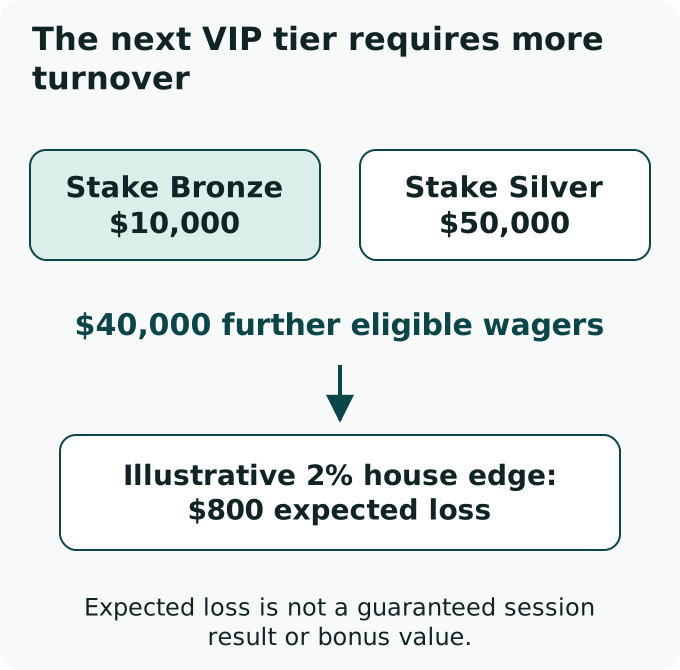
From the Stake VIP tier review, 2026. Stake rakeback: 3.5% at current tier level, disclosed on the dashboard. Next tier qualification: $50,000 additional wager volume required. Incremental rakeback gain: 0.5% on future wagers. Pre-compute: $50,000 × 4% house edge = $2,000 cost to qualify; $50,000 × 0.5% incremental rakeback = $250 benefit. Net: -$1,750. The tier upgrade would cost $1,750 more than it returns at the projected play volume. Tier maintenance wagering declined; funds withdrawn rather than committed to the qualification grind.

From the Stake VIP host outreach, 2026. Host message: "exclusive reload €500 at 35x wagering, one-time offer, expires tonight." Written response requested with full T&C document. Host sent the T&C attachment the next morning, 14 hours after the "expires tonight" deadline. The offer was still valid. T&C review showed: base = bonus + deposit, so €500 bonus + €500 deposit × 35x = €35,000 required wager. The standard public reload on the same brand was 45x on bonus only: €500 × 45x = €22,500 required wager. The "exclusive" host offer required $12,500 more wagering than the public offer. The written T&C review caught the base-shift; the urgency framing was designed to prevent it.

From the Shuffle VIP tier tracking, 2026. Shuffle's SHFL token tier reset mechanics: active-volume requirements on a rolling 30-day window. At day 28 of the cycle, the tier was within 2 weeks of reset. The natural response would have been to wager $1,200 over two days to keep the tier active. Pre-compute: $1,200 × 4% house edge = $48 expected loss to maintain the SHFL staking tier worth approximately $8.40/month at the current token price. Bankroll withdrawn; tier allowed to reset. The $48 maintenance cost to preserve an $8.40/month benefit is a 5.7-month payback at zero variance, structurally negative at any reasonable time discount.

These three habits, applied consistently, neutralise the VIP trap mathematics. The player who treats VIP as informational rather than aspirational keeps the bankroll discipline intact.

A real test on a brand from my index

The example below is from my testing notes on one of the brands currently on my feedbacks index, where I declined a silver-to-gold promotion despite the VIP host pushing back twice.

The decline I logged. At silver tier on a Curaçao brand, $400 of cumulative deposit, I received a VIP-host outreach offering a "fast-track to gold" if I wagered $20,000 in the next 14 days. The benefit at gold tier was rakeback raised from 4% to 7%, withdrawal speed dropped from 24 to 6 hours, and a $500 "exclusive" reload bonus. I ran the math: $20,000 × 4% house edge = $800 expected loss; incremental rakeback over 14 days at the new rate ≈ $40; the $500 reload was sticky with 30x wagering (I asked for the T&C). Net expected deficit: $760 from wagering minus $40 rakeback minus $0 net from the sticky reload = -$720. I emailed the host declining and explained the math politely. The host responded "understood, the offer remains open if you change your mind". The offer was structural; my decline was structural too.

The lesson from that decline is that the VIP trap is not always presented as a trap; it is presented as a perk by a well-trained host. The math is the truth-test, and the math is the same regardless of how friendly the conversation is.

The VIP math rule. Every tier-upgrade offer requires five minutes and a calculator before any answer. Total expected loss = qualifying wagered volume × house edge. Incremental benefit = that volume × the rakeback rate difference. If the loss exceeds the benefit, the promotion is a net cost, regardless of how it is framed by the host. The silver-to-gold example above walks this arithmetic in full. Apply the same formula to every tier offer before accepting.

FAQ on casino VIP traps

Q: What are casino VIP traps in plain terms?

A: VIP traps are structural patterns inside a casino loyalty programme that turn perceived perks into net player losses. They include hidden wagering volume requirements to qualify or maintain tier, sticky VIP-only bonuses, opaque retention offers from VIP hosts, and tier-reset mechanics that force constant play. The trap is mathematical, not behavioural; the marketing surfaces benefits and hides costs.

Q: How does a VIP host pressure a player into accepting a hostile offer?

A: Common patterns: urgency framing ("this is a 24-hour exclusive offer"), relationship framing ("you have been a valued player for X months"), partial-disclosure ("the full T&C will be shared after you accept"), and reciprocity ("we noticed your recent activity and want to give back"). The honest response is to demand full written T&C, take 24 hours to compute the math, and decline if the math is negative.

Q: Is the VIP host a bot or a real person?

A: On most brands, a real person trained on a retention script with revenue targets. The host's job is not to be the player's advocate; the job is to maintain or grow the player's wagered volume on the brand. This is not a moral judgment, just a structural fact. Read the host's offers as commercial proposals, not as friendly gestures.

The VIP trap calculation in one line. Expected cost = qualifying wagered volume × house edge. Incremental benefit = that same volume × the rakeback rate difference between tiers. If cost exceeds benefit, the promotion is a net loss regardless of how the host frames it. On the silver-to-gold example above: cost ≈ $875, benefit ≈ $26, net deficit ≈ $850. Run this arithmetic before any tier-upgrade answer.

Escape and protection questions

Q: VIP traps vs welcome bonus traps, what is the difference?

A: Welcome bonus traps fire once, at the start of a brand relationship, on a small dollar amount. VIP traps fire repeatedly, after the player has built up a history, on much larger dollar amounts. The math is similar; the stakes are an order of magnitude higher. A welcome bonus loss is $200 of bad math; a VIP cycle loss is $2,000 of bad math.

Q: How much can a single VIP trap cost the player?

A: On the silver-to-gold example walked above, approximately $700-$900 of expected deficit on a single 30-day upgrade cycle. Across a year of monthly tier-maintenance cycles, the cumulative cost can exceed the player's annual deposit budget. The deficit is recurring, not one-off, which is the structural difference from welcome bonuses.

Q: Can a player opt out of a VIP programme without losing perks they have already earned?

A: Most brands allow opt-out from VIP host outreach without affecting baseline perks like standard rakeback rate. The opt-out is in the responsible-gambling or marketing-communications settings, sometimes in the VIP-specific settings. Tier-status perks (rakeback rate, withdrawal speed) usually remain at the earned level for the standard reset window after opt-out. Read the brand's specific VIP T&C for the exact policy.

Q: Are there brands without VIP traps?

A: A few brands offer flat-rate rakeback with no tier structure, no maintenance wagering, and no retention-host outreach. These are mathematically the cleanest loyalty offerings. They are also rare; most brands rely on the tier structure for retention margin. The brands on my feedbacks index include both kinds, with the verdict colour reflecting the brand vibe difference.

Related entries on Casino Feedback

Questions on a specific brand's VIP programme go to smartseokings@gmail.com. Replied within twenty-four hours.

Get every VIP commitment in writing in the account T&C or a signed addendum before depositing toward a tier. Verbal commitments from VIP hosts are not enforceable. The tier requirements and the benefit schedule should be visible in plain text before the first large deposit.