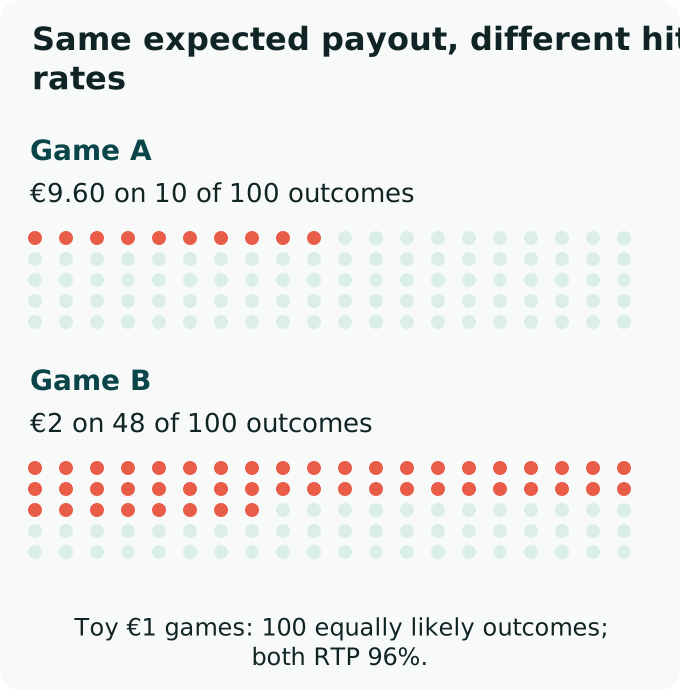

RTP vs hit frequency is the comparison every slot player should be able to make in their head before clicking spin. RTP describes the long-run percentage of wagered money the game returns to the player population. Hit frequency describes how often any single spin produces a win larger than zero. They measure different things; neither alone tells you whether a session will feel painful or pleasant. This entry on Casino Feedback breaks down the math, the variance band, and how the two numbers fit onto the six-axis editorial scorecard.
Snapshot. RTP is the asymptotic return percentage of a slot, usually 94% to 97% on regulated games. Hit frequency is the percentage of spins that pay back something, usually 18% to 35% depending on the volatility class. A 96.5% RTP slot with 22% hit frequency is mathematically very different from a 96.5% RTP slot with 32% hit frequency, even though the long-run payout is identical. Across the brands on my feedbacks index, the gap between these two numbers determines whether your session ends with the bonus cleared or with a $282 deficit on the wagering meter.
What RTP and hit frequency actually measure on a slot
Return to Player (RTP) is the percentage of total wagered amounts that a slot is mathematically designed to return to the player population over a very large sample (usually 10 million to 1 billion simulated spins). A 96.5% RTP means that across that population, $100 wagered returns $96.50 on average and $3.50 stays with the house. The audit certificates from iTech Labs, GLI, and eCOGRA verify this number against the game's published math model. The certificate is on the game info page on most reputable brands.
Hit frequency is the percentage of spins that produce a return greater than zero, regardless of how small. A 25% hit frequency means one spin in four pays back something, and three spins in four are full losses. The hit frequency includes "low-pay" spins where the return is less than the stake (a $1 spin that pays $0.30 still counts as a hit), so the metric is generous on the surface. Volatility class shapes hit frequency: a low-variance slot might run 35% hits, a high-variance slot might run 18%.
The two numbers are independent. RTP can be identical across two slots while hit frequency varies by 50%, and the player experience differs by an enormous margin even though the long-run math is the same.
How RTP vs hit frequency translates to a real session
The cleanest way to see the gap between RTP and hit frequency is to run two simulations on slots with identical RTP and different volatility. The walkthrough below is the kind of arithmetic I do on a calculator before any new welcome cycle.
The two-slot comparison. Take two slots both rated at 96.5% RTP. Slot A is a low-variance grid game with 32% hit frequency and small average wins. Slot B is a high-variance Megaways game with 19% hit frequency and large but rare wins.
On a $200 deposit with a $1 bet size, 200 spins each:
- Slot A (32% hit). Approximately 64 winning spins, 136 losing spins. Average win on a hit ≈ $1.74. Total return ≈ $111.40. End balance ≈ $111. Session feels survivable; many small wins keep the bankroll cycling.
- Slot B (19% hit). Approximately 38 winning spins, 162 losing spins. Average win on a hit ≈ $2.93. Total return ≈ $111.30. End balance ≈ $111. Same math; the wins are bigger but rarer, and most sessions end below $50 with no big hit.
Both slots return ~96.5% RTP after a long sample. In a 200-spin session, slot A ends within 20% of the expected $193 around 60% of the time. Slot B ends within 20% of $193 around 25% of the time, and ends below $50 around 35% of the time. The RTP is identical; the player experience is completely different.
The session-level distribution is what separates a slot that "feels right" from a slot that drains the bankroll silently. Hit frequency is the metric that controls that distribution; RTP only controls the centre of mass.
Where RTP and hit frequency are published, and where they hide
The two numbers are not equally visible on a casino interface. RTP is regulated and audited; hit frequency is sometimes published, sometimes not, and never audited at the certificate level.
| Source | RTP availability | Hit frequency availability |
|---|---|---|
| Game info page on the casino | Required on regulated brands | Sometimes shown, often missing |
| Provider site (Pragmatic, NetEnt, Hacksaw) | Always published | Usually in the help / mechanics section |
| Independent databases (BigWinBoard, SlotCatalog) | Indexed for thousands of titles | Sometimes present, often estimated from population data |
| Audit certificate (iTech Labs / GLI / eCOGRA) | Verified against game math | Not part of standard audit |
| RTP version configurable by brand (some Pragmatic titles) | Multiple variants, must check the actual version shipped | Same variance, different RTP |
The fact that some Pragmatic Play slots ship with three or more RTP variants (the same game configured at 96.5%, 94.0%, 93.5%, or sometimes 88%) is its own scorecard signal. Brands that ship the lowest-RTP variant without disclosing it score down on brand vibe; brands that surface the variant in the game info page score up. The low-RTP discovery diary on the stories archive is the longest case study of this pattern.
How RTP vs hit frequency fits onto the six-axis scorecard
On the six-axis scorecard RTP and hit frequency are not their own axis; they bleed into two of them.
- Bonus math. The expected deficit on a welcome bonus depends on both RTP and the wagering multiplier. A 40x wagering on a 96.5% RTP slot has the same expected deficit regardless of hit frequency, but the variance band around that expected outcome is much wider on a low-hit-frequency slot. The wagering math entry on wagering requirements walks the full calculation.
- Brand vibe. A brand that surfaces the actual RTP variant of each title in the lobby scores up. A brand that ships a low-variance Pragmatic title at 93.5% without disclosing the variant scores down. Per eCOGRA RTP audit guidance, the brand has a duty to surface variant information, but enforcement is weak.
The remaining four axes (cashier behaviour, support quality, KYC handling, wallet timeline) are independent of slot math. A high-RTP brand can still freeze withdrawals or run hostile KYC, and a low-RTP brand can still run a clean cashier. The slot math is one input; the verdict colour comes from the full six-axis read.
A real welcome cycle: how the numbers played out
The seo description on this page references a $282 deficit. Below is the math behind that number, from a welcome cycle I logged in my testing window on a brand on the feedbacks index.
The cycle. $200 deposit, 100% welcome bonus, $200 bonus balance, 40x wagering on the bonus portion. Wagering volume required: $8,000. Played through on a slot with 96.5% advertised RTP and an estimated 22% hit frequency from third-party data. Expected loss on $8,000 wagered at 3.5% house edge: $280. Actual outcome at the end of the wagering session: $282 deficit between starting balance ($200 deposit + $200 bonus = $400) and cleared withdrawable ($118). The math hit the expected value within $2.
The lesson from the cycle is that the 96.5% RTP played out exactly as advertised in expectation, but the variance felt much harsher than a higher-hit-frequency slot would have made it feel. The bankroll dropped to $54 at one point in the session before recovering to $118 final. On a slot with 32% hit frequency, the same drop would have been around $108. Same RTP, different ride.
Three habits I keep before choosing a slot session
These are the three checks I run before any session on a new slot, and they take less than two minutes once you have practiced them.
From the low-RTP discovery diary preparation data. Pragmatic Play ships Sweet Bonanza in three RTP variants: 96.51%, 94.1%, 92.5%. The operator-deployed variant is visible in the in-game "i" modal, the same paytable screen that shows the max win multiplier. During a brand review cycle, the same title showed 92.5% on one brand and 96.51% on another. House edge difference: 7.5% vs 3.49%. On a €12,000 wagering requirement, the expected loss differential is €486 vs €419, a €67 difference that the modal check takes 8 seconds to discover. The check is now a standard step in the pre-deposit protocol for any wagering cycle.
From the Gamdom Slot Battles review, 2026. Slot Battles are competitive wagering events where the qualifying metric is max win within a fixed number of spins. Pre-entry check: Pragmatic Play game help section for hit frequency of three candidate titles. Results: Fruit Party (hit frequency 23.4%), Gates of Olympus (24.3%), Big Bass Splash (32.8%). For a Slot Battle where a single large win wins the round, low hit frequency (Gates of Olympus) maximises the variance needed to hit the top prize. For a Slot Battle where total win across 50 spins is scored, higher hit frequency (Big Bass Splash) sustains the score through the spin count. The provider-published hit frequency changed the game selection on both criteria.
From the 1xSlots wagering cycle, March 2026. Welcome bonus: €200, 40x wagering, base = bonus + deposit = €300, required wager = €12,000. Game selection for the wagering run: medium-variance slots at 96.5% RTP, hit frequency above 25%. High-variance Megaways were available and offered higher entertainment; at €12,000 required wager, the spin count at €5 ceiling bet = 2,400 spins. A 96% RTP slot at 2,400 spins has enough samples to approach the statistical mean; the same stake on a 5-line Megaways at 20% hit frequency runs out of meaningful hit density at €5/spin. The wagering cycle completed in 4 sessions across 6 days without a bonus void.
The slot math is not random in the colloquial sense; it is structured randomness with a known distribution. Reading the distribution before sitting down at the table is the cheapest discipline a player can keep.
Frequently asked questions on slot variance mathematics
Q: What is the difference between RTP and hit frequency in plain language?
A: RTP is the average percentage of wagered money a slot pays back over a very long sample. Hit frequency is the percentage of individual spins that return anything above zero. A slot can have high RTP and low hit frequency (rare big wins) or high RTP and high hit frequency (frequent small wins); both versions return the same percentage over time, but the session feel is completely different.
Q: How does hit frequency change the volatility of a slot?
A: Hit frequency is the inverse face of volatility. Low hit frequency means most spins lose, with rare large wins; this is high volatility. High hit frequency means most spins pay something small; this is low volatility. The mathematical relationship is not strict, because hit frequency does not include win size, but as a rough guide: <20% hit frequency is usually high-volatility, >30% is low-volatility, in-between is medium.
Q: Is a higher RTP always better for the player?
A: Mathematically yes, in expectation. A 96.5% RTP slot returns more to the population than a 94% RTP slot, both over a long sample. But on a single session, hit frequency and variance matter more than the small RTP gap. A 94% RTP slot with 32% hit frequency may feel and play better than a 96.5% RTP slot with 19% hit frequency for a small bankroll session. Match the slot to the bankroll.
Practical session questions
Q: RTP vs return percentage, are they the same metric?
A: Yes. "Return to Player" and "return percentage" refer to the same statistic. Different jurisdictions use different conventions in the certificates (some publish the house edge instead, which is 100% minus RTP). Per GLI standard GLI-19, the audit covers both metrics; they are mathematically equivalent.
Q: How long does a slot session need to be for RTP to converge to the advertised number?
A: For the player population, RTP converges at roughly 10 million spins of cumulative data; the audit relies on at least that. For a single player, even 10,000 personal spins on the same slot can show ±5% variation around the advertised RTP. The convergence is statistical and slow; a single session of 200 spins is not a meaningful sample for either RTP or hit frequency.
Q: Why do brands ship different RTP variants of the same Pragmatic slot?
A: Pragmatic, and a few other providers, allow brands to license multiple RTP variants of the same title (typically 96.5%, 94.0%, 93.5%, and sometimes 88%). The brand pays less for the lower-RTP variant and keeps more of the wagered volume. The variant choice is disclosed in the game info modal; brands that hide the variant are doing brand-vibe damage. The low-RTP discovery diary on the stories archive documents the practice across the industry.
Related entries on Casino Feedback
- Wagering requirements covers the bonus math that interacts with RTP to define the deficit.
- The PF-protocol primer covers what the transparency mechanism does not prove about RTP on crypto-first slots.
- Max bet rule covers the bet-size constraint that interacts with variance during wagering.
- The low-RTP discovery diary documents the most explicit case of variant ship behaviour.
RTP-variant questions on a specific brand go to smartseokings@gmail.com. Replied within twenty-four hours.
Check the game info modal RTP on the first spin of a new brand, before committing the full session stake. The configured variant is visible in one click. If it differs from the provider's published default, the expected depletion rate doubles at the same stake size.