

Game maths
Slot volatility and the size of payout swings
Slot volatility describes how widely payouts vary, including their size and frequency. A game built around rare large prizes can produce wider balance swings than one returning smaller amounts more often, even when their theoretical RTP is identical.
RTP describes the average return. Volatility describes the spread around it. Neither predicts which result your next spin will produce.
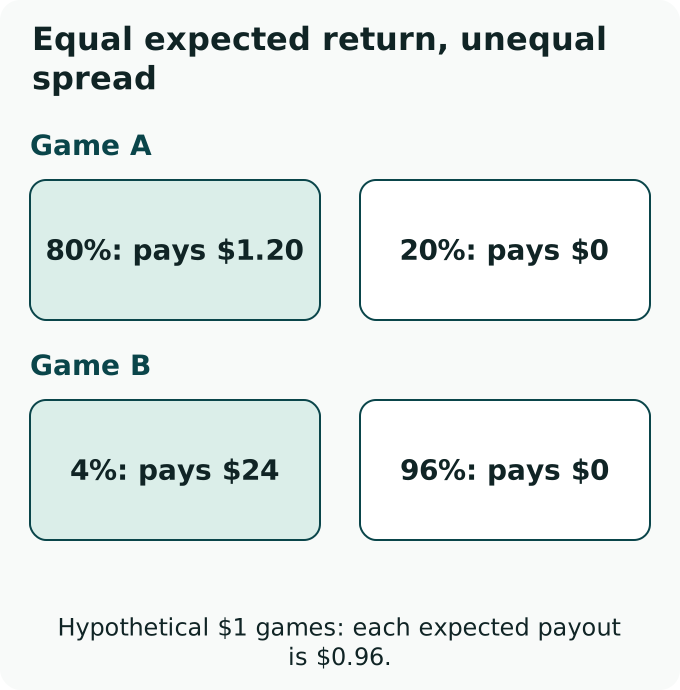
Same RTP, different payout distributions
| Measure | Game A | Game B |
|---|---|---|
| Chance of a paying round | 80% | 4% |
| Payout on a paying round | $1.20 | $24 |
| Payout on every other round | $0 | $0 |
| Expected payout per $1 wager | 80% × $1.20 = $0.96 | 4% × $24 = $0.96 |
| Theoretical RTP | 96% | 96% |
These are simple mathematical models, not real slots or a promise about how many wins occur in a particular session.
The mean hides the size of each change
Game A changes the balance by a $0.20 profit on a paying round or a $1 loss on a non-paying round. Game B produces a $23 profit or a $1 loss. Both have the same expected loss of $0.04 per round, but Game B concentrates its returns into much rarer, larger payouts.
That greater spread is the point of volatility. Mathematically, it can be measured with variance or standard deviation. A label such as high volatility communicates a broad classification; it does not give an exact probability for the next spin.
Hit frequency answers a narrower question
Hit frequency counts how often a paying result occurs. It does not describe the sizes of all those payouts. A game can pay small amounts frequently and still reserve a large share of its return for rare prizes.
A paying result can also return less than the stake. Getting a payout is therefore not always the same as making a profit on that round. The RTP vs hit frequency entry separates these measures without treating a frequent hit as a favourable expected return.
A quiet spell does not schedule the next win
Read the label alongside your stake
With a hypothetical $40 playing budget, $1 stakes allow 40 wagers before accounting for any returns. At $0.50, the same budget allows 80. Payouts, stopping decisions and the actual game distribution change how a session develops; those counts are an initial stake calculation, not promised session lengths.
Use volatility to understand the sort of swings you are accepting at that stake size. Lower volatility does not make a session loss-free, and a high-volatility label does not promise a large win. Check the game's stated classification rather than assuming every supplier uses an identical rating scale.
Does high volatility mean lower RTP?
No. RTP and volatility measure different properties. The two hypothetical games here both return $0.96 per $1 wager in expectation, while the second has a much wider payout distribution.
Can low volatility guarantee frequent profitable spins?
No. A volatility label does not specify an exact hit rate, and a hit can return less than the stake. Use the game's payout information for those details.
Continue with the question that matters
- RTP vs hit frequency
Average return and paying-round frequency are different measures.
- House edge
Express the expected loss rate rather than the payout spread.
- Bankroll
Define the money exposed to those swings.