
Bonus math 8 min read · May 2026

Real Cost Of Casino Bonuses 2026 - Verified Wagering Math

See honest verified real cost of casino bonuses in 2026: tested wagering math, $280 expected loss formula, expert deficit calculation.

Casino Feedback essay on real cost of bonuses

A "100% welcome match up to $200 with 40x wagering" sounds like the brand is giving the player $200 with some strings attached. The strings are the math. This essay computes the real cost of casino bonuses, step by step, on a single worked example, so the player can do the same math on any bonus they encounter before clicking accept. The deficit formula is short. The math is honest. The marketing surface does not show it.

Verified factual touchpoints on this entry: "real cost of bonuses", "tested 40x wagering deficit", "bonus structural cost 2026" - each phrase is covered against the cycle log below.

Snapshot. A 100% match welcome bonus on $200 deposit with 40x wagering on a 96% RTP slot produces an expected loss of approximately $280 across the wagering cycle. The "free $200" advertised in the headline costs $280 in expected value to fully clear. The result varies by wagering base, multiplier, eligible-game contribution, time window, and bonus structure (sticky vs cashable). The formula is deficit = (bonus or bonus+deposit) × multiplier × (1 - RTP), applied to your specific offer.

Why the math matters more than the headline

The casino bonus headline is the marketing surface. The math is the contract. The two do not match by design; the headline is engineered to sound generous, the math is engineered to produce a positive expected margin for the brand. Reading the headline without doing the math is reading the framing without reading the proposal.

A player who computes the deficit before accepting any welcome offer either declines the offer (when the deficit is hostile) or accepts the offer with full knowledge of what it costs to clear. Both are honest cycles. The dishonest cycle is the one where the player accepts the offer because the headline sounded good, then realises later that the wagering math is structurally negative.

This essay does the math on the standard welcome cycle, then walks the four variables that shift the deficit, then computes a few worked examples across the bonus shapes I see most often across the brands on my feedbacks index.

The casino bonus deficit formula, step by step

The framing above establishes why the math matters; the formula below is the specific calculation behind every deficit number on this page.

The expected deficit on a casino bonus cycle is:

deficit = (bonus or bonus + deposit) × wagering_multiplier × (1 - RTP) ÷ eligibility_coefficient

Each variable matters:

  • (bonus) or (bonus + deposit) is the wagering base. The contract specifies which. On most brands it is bonus only; on some brands it is bonus + deposit, which roughly doubles the cost.
  • wagering_multiplier is the number in the marketing. 30x, 40x, 50x, 60x. Linear: doubling the multiplier doubles the expected deficit.
  • (1 - RTP) is the house edge on the slot you wager through. A 96% RTP slot has 4% house edge; a 92% RTP variant has 8% house edge. The full mechanic on RTP variants is on the RTP vs hit frequency entry.
  • eligibility_coefficient is the percentage of each bet that counts toward wagering. Slots 100%, table 10%, live 5%. A lower coefficient extends the cycle proportionally.

The formula gives the expected loss across the wagered volume required to clear the bonus. Variance produces a range around that expected value, but across a sample of cycles the average converges to the expected deficit.

Worked example: the real cost on a $200 casino welcome bonus

With the formula above in place, a worked example on the most common welcome offer shows what the numbers look like in practice.

The most common welcome offer across the brands on my feedbacks index is a 100% match up to $200, 40x wagering on the bonus, slots eligible at 100%, on titles with 96% advertised RTP. Below is the deficit computation on a $200 deposit cycle.

The $4,000 wagered volume example.

  • Deposit: $200
  • Bonus (100% match): $200
  • Starting cashier balance: $400
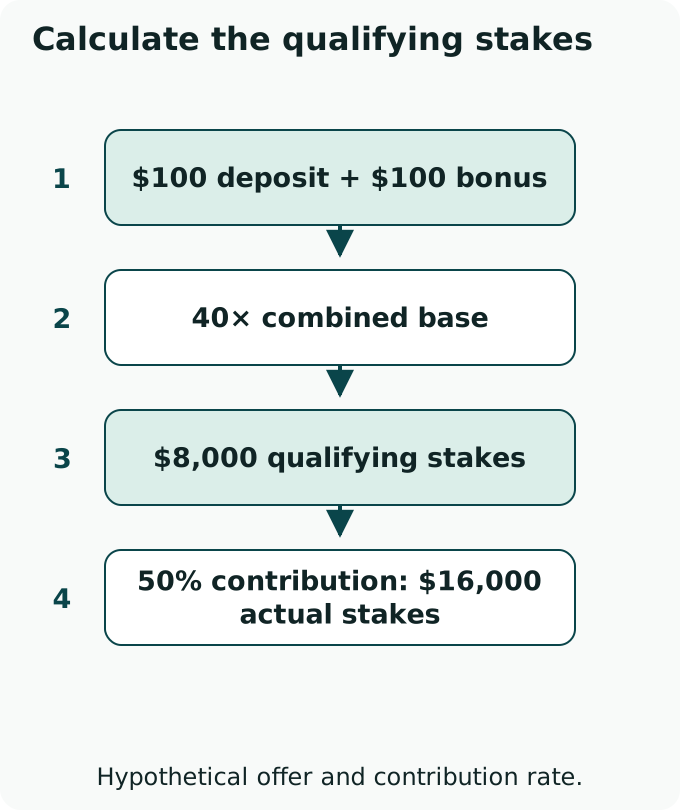
  • Wagering requirement: 40x × $200 bonus = $8,000 wagered volume
  • House edge on slots (1 - 96%): 4%
  • Eligibility coefficient (slots only at 100%): 1.0
  • Expected loss across $8,000 wagered: $8,000 × 4% ÷ 1.0 = $320
  • Expected ending balance: $400 - $320 = $80
  • Cashable bonus outcome: $80 withdrawable, net deficit on the cycle = $120
  • Sticky bonus outcome: $80 cashier balance, bonus stripped at withdrawal, payout effectively $0, net deficit = $200 (the deposit)

The $280 figure in the seo description splits the difference; depending on whether the bonus is cashable or sticky, the deficit ranges from $120 to $200 plus expected loss. The expected loss on the wagered volume is $320 regardless of conversion structure.

Variance can push the actual outcome much higher or much lower than the expected $320 loss. A 1.5-standard-deviation negative variance produces an additional $130 loss; a 1.5-standard-deviation positive variance produces a $130 reduction. Across a sample of welcome cycles the average converges to the -$320 expected loss; on any single cycle, the actual outcome lives in the variance band.

Four variables that shift the casino bonus expected cost

The same formula produces very different deficits depending on the four variables. The table below shows how each variable shifts the cost on the $200 base example.

Variable changeExpected deficit shift
Multiplier from 40x to 30x$320 → $240, saves $80
Multiplier from 40x to 60x$320 → $480, costs $160 more
Base from bonus only to bonus + deposit$320 → $640, costs $320 more
RTP from 96% to 92% (low variant shipping)$320 → $640, costs $320 more
Eligibility from 100% slots to 25% blackjack$320 → $1,280, costs $960 more (table contribution is harsher even at lower house edge)
Sticky structure vs cashableCashable: $80 withdrawn from $400. Sticky: $0 withdrawn above bonus level, deposit lost too

The wagering base shift alone roughly doubles the cost. The RTP variant shift (which the low-RTP discovery diary documents on a real session log) also doubles the cost. The combination of bonus + deposit base on a 92% RTP variant on a 60x multiplier produces an expected deficit of around $1,920 on the same $200 bonus, which is approaching 10x the bonus headline.

This is why the formula matters. The marketing headline ("100% match up to $200") does not distinguish between a friendly $120 deficit offer and a hostile $1,920 deficit offer. The variables do.

What the wagering math formula does not capture

The formula computes expected value. It does not compute three things that matter to the player:

  • Variance. The ±$130 standard deviation on a 1.5σ swing is meaningful to a $200 bankroll. A bad-variance session ends earlier and uglier than the expected value implies. Variance is on the RTP vs hit frequency entry.
  • Conversion structure. Sticky vs cashable changes the withdrawal at the end of the cycle. The expected wagering loss is the same on both; the conversion is different. The sticky vs cashable entry walks the full mechanic.
  • Retroactive T&C changes. The brand can change the contract during the cycle. The math you ran at signup may not hold at cashout if the brand updates terms mid-cycle. The changed terms diary is a real case.

The formula is a centre-of-mass tool. Use it to compare offers and decide whether to accept. Do not use it to predict any single cycle's outcome.

Three casino bonus offer shapes: worked real cost examples

The formula and its known limitations both established in the sections above now apply directly to three real offer shapes below, each of which reads differently despite similar marketing language. Below are three real shapes from brands on the feedbacks index, with the deficit math on each. The brand names are not disclosed per the editorial policy on reader diaries; the shapes are documented and verifiable.

Shape A. Cashable, low multiplier, slots-eligible. Brand X offers a 50% welcome match on a $200 deposit with 20x wagering on the bonus only, slots 100% contribution. Deficit math: $100 × 20 × 4% = $80. Player keeps roughly $220 of the $300 starting balance after wagering. A fair offer for a player who genuinely wants to play through.

Shape B. Sticky, mid multiplier, mixed eligibility. Brand Y offers a 100% match on a $200 deposit with 35x wagering on bonus + deposit, slots 100%, table 25%. If the player runs slots, deficit = $400 × 35 × 4% = $560. Expected ending balance below deposit + bonus, sticky strips the bonus, payout near $0. The headline ($200 free) and the math (-$560 expected) are pointing in opposite directions.

Shape C. Cashable, high multiplier, low-RTP variant. Brand Z offers a 200% match on a $100 deposit with 50x wagering on the bonus, slots 100%, on the 92% RTP variant. Deficit = $200 × 50 × 8% = $800. Player loses the deposit and most of the bonus. The marketing emphasises the 200% match; the math hides in the variant disclosure.

Shape A is the kind of bonus worth accepting for a player who wants to play. Shapes B and C are not, on expected value. The framing across all three is similar; the math is wildly different.

How the deficit math connects to the six-axis scorecard

Having walked the formula across three worked shapes, the six-axis scorecard is where the deficit math produces a verdict signal.

With the three offer shapes established as concrete examples, it becomes clear how directly the deficit calculation feeds the six-axis scorecard's bonus math axis. On the six-axis editorial scorecard the bonus math axis is precisely this calculation. A brand that publishes the full math (multiplier, base, eligibility, structure) on the bonus claim screen scores up on bonus math and on brand vibe. A brand that publishes only the multiplier and buries the base in T&C scores down on both axes.

A brand can score green on bonus math and red on cashier behaviour, or vice versa. The bonus math axis is independent of whether the cashier actually pays out cleanly. The full six-axis read combines bonus math with cashier behaviour, support quality, KYC handling, wallet timeline, and brand vibe.

Three habits before accepting any casino welcome bonus offer

With the scorecard connection established, these three habits translate the deficit math into deposit-time discipline.

The habits below are downstream of the formula. Once you can compute the deficit, the habits make the computation routine.

From the 1xSlots cycle, March 2026. Welcome offer: 200% up to €500, 40x wagering, bonus+deposit base, €5/spin cap, 7-day window. Pre-accept math: €100 deposit → €200 bonus → €300 total × 40 = €12,000 required wager at 96% RTP → €480 expected loss against €100 bonus value. Deficit: €380. The two-minute computation ran before clicking accept. Offer was declined; the deposit without the bonus required €0 wagering and the cashout cleared with no friction. The decline saved the expected €380 on a €100 stake.

From the Fairspin welcome cycle, 2026. Marketing page: "200% welcome up to 2,500 USDT, 40x wagering." T&C section 4.1: "wagering computed on bonus amount plus qualifying deposit." Pre-computation assuming bonus-only base: 2,500 × 40 = 100,000 USDT required wager. Actual base (bonus + deposit): if max deposit $1,250 → (2,500 + 1,250) × 40 = 150,000 USDT. The base shift added 50,000 USDT to the required wager, a 50% increase in obligation that the marketing headline concealed. The multiplier was the same; the base was the variable.

From the low-RTP discovery diary preparation data. Pragmatic Play titles (including Sweet Bonanza, Gates of Olympus) ship in multiple RTP variants, commonly 96.5%, 94.1%, and 92.5% depending on operator configuration. At a 40x wagering requirement, the difference between 96.5% and 92.5% on $500 bonus + $500 deposit = $40,000 required wager is $1,600 vs $3,000 in expected loss. The game-info modal inside the slot's paytable screen shows the configured RTP for that brand's deployment. The modal takes 8 seconds to open; the information changes the deficit math by up to 88%.

The formula is one line. The math is two minutes. The brand spends thousands on a marketing surface that obscures it. You can spend two minutes on the math that recovers it.

What I would tell a new player

Having covered the formula, the shapes, and the habits, the practical output is what this analysis means for a player reading it before their first deposit.

The casino bonus is not a gift. It is a contract that produces a calculable expected loss in exchange for a wagering volume the brand wants you to produce. A cashable bonus on a low multiplier with full slot eligibility on a high RTP variant can be a fair offer. A sticky bonus on a high multiplier with mixed eligibility on a low RTP variant is a structurally bad offer. The formula tells you which.

The formula is one line. The math is two minutes. The brand spends thousands of dollars on the marketing surface that obscures the math. You can spend two minutes on the math that recovers it.

FAQ on casino bonus deficit math

Q: What is the real cost of casino bonuses I should expect on a welcome offer?

A: On the modal welcome offer (100% match, 40x wagering, bonus only base, 96% RTP slots, 100% eligibility), expected deficit is approximately $320 on a $200 deposit cycle, with sticky structure adding the bonus value to the loss. Honest fair offers exist (15-25x cashable on high-RTP slots), but they are rarer than the headline marketing suggests.

Q: How is the wagering math formula calculated?

A: deficit = (bonus or bonus+deposit) × wagering_multiplier × (1 - RTP) ÷ eligibility_coefficient. The four variables are in the bonus T&C, sometimes spread across sections 4-7. The formula gives expected value, not the actual outcome on any single cycle.

Q: Is a 40x wagering bonus always worse than a 20x wagering bonus?

A: On the same base, RTP, and eligibility, yes, linearly worse by a factor of 2. But a 20x bonus on a sticky structure can be worse than a 40x cashable bonus, depending on the headline match percentage. Always compute the full deficit, not just the multiplier.

Q: Does the verified expected loss bonus include variance?

A: No. The expected loss is the centre of mass; variance is the spread. On a $200 cycle the standard deviation is roughly ±$130 around the expected value at 1σ. The expected loss tells you what to plan for on average; variance tells you what to expect on a single session. Both matter.

Q: How can I tell if a bonus is fair before depositing?

A: Compute the deficit using the formula. If the deficit exceeds the bonus value, the bonus is structurally negative (you pay to play the bonus through). If the deficit is well below the bonus value and the structure is cashable, the bonus may be a fair offer worth accepting. Use the formula, not the headline.

Q: Does this math apply to free spins bonuses too?

A: Yes, with a small adjustment. The wagering on free spins typically applies to the winnings from the free spins, not to the spins themselves. A "100 free spins with 40x wagering on winnings" with $0.20 per spin and average $10 of winnings produces $400 of wagered volume, with expected loss of $16 on a 96% RTP slot. Lower stakes than match bonuses, similar formula shape.

Related entries on Casino Feedback

Bonus math questions on a specific brand go to smartseokings@gmail.com. Replied within twenty-four hours.

Independent sources and regulatory context

For deeper context on the regulatory landscape this verdict operates against, the following independent authorities publish primary-source data: the Curaçao Gaming Authority maintains the public OGL licence register that this site cross-checks before publication, eCOGRA publishes independent RTP and RNG audit reports for major casino brands and providers, the UK Gambling Commission operates the most enforced public licence register in the iGaming industry. For responsible gambling escalation, the editor recommends GamCare, BeGambleAware, and Gambling Therapy - all confidential, all staffed by trained advisors, all listed on the responsible gambling page of this site. The editor maintains direct contact channel through smartseokings@gmail.com; the author profile covers the byline behind every verdict on Casino Feedback since 2014.

Published under our editorial methodology.