Glossary entry 4 min read · Apr 2026

Wagering Requirements Explained 2026 - Verified 40x Math

See honest wagering requirements explained: verified 40x bonus math tested in 2026, $4,000 wagered volume example, expert deficit formula.

Casino Feedback explainer on wagering requirements

Wagering requirements are the volume of bets a player must place before a bonus converts to withdrawable cash. The headline number sits on every welcome bonus page across the brands on my feedbacks index, usually as "40x" or "35x" without further explanation. The math behind that multiplier determines whether a welcome bonus is a fair offer, a small subsidy, or a structural loss. This entry on Casino Feedback walks the full formula, computes a $4,000 wagered volume example on a real welcome cycle, and shows how the bonus math axis on the six-axis editorial scorecard reads the deficit.

Snapshot. Wagering requirements multiply the bonus (or bonus + deposit, depending on the brand) by a number between 10 and 60 to produce the total wagered volume the player must run through before withdrawing. On a $100 bonus with 40x wagering, the volume requirement is $4,000. Combined with a 4% house edge slot, the expected deficit is $160 before a single cashout can be requested. The multiplier itself is half the story; the eligible-game coefficient, the bet-size ceiling, and the time window all shift the real cost meaningfully.

What casino wagering requirements actually are on wagering requirements explained

A wagering requirement is the contractual condition attached to a casino bonus that specifies how much wagered volume the player must place before the bonus money becomes withdrawable. The multiplier (e.g. "40x") is applied to a specific base, usually one of three options:

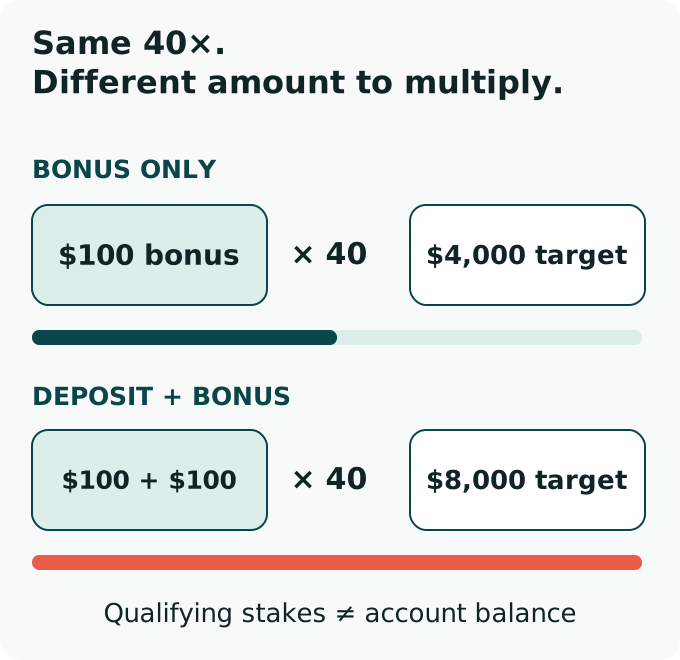
  • 40x bonus. The volume requirement is the bonus times the multiplier. A $100 bonus at 40x = $4,000 wagered volume. This is the most common structure on the brands I track.
  • 40x bonus + deposit. The volume is (bonus + deposit) times the multiplier. A $100 bonus + $100 deposit at 40x = $8,000 wagered volume. This is harsher and roughly doubles the structural cost.
  • 40x deposit only (rare). The volume is the deposit times the multiplier. Usually accompanies a fully cashable structure on smaller welcome offers. Most common on European MGA-licensed brands.

The multiplier alone is the marketing headline. The base is the math. A "30x" wagering on (bonus + deposit) is mathematically equivalent to "60x" on bonus only, and brands sometimes use the lower number deliberately to make the offer look more attractive.

The wagered volume is the cumulative spend during the wagering phase, not the net spend. Wins and losses both count toward the meter on every spin; a $1 stake contributes $1 to the volume regardless of whether the spin paid back $0, $1, or $50.

How wagering math actually computes on a real cycle on wagering requirements explained

The cleanest single example is a 40x wagering on a 100% match welcome bonus, which is the modal welcome offer across the feedbacks index. The walkthrough below uses round numbers for clarity.

The $4,000 wagered volume example.

  • Deposit: $100
  • Welcome bonus (100% match): $100
  • Starting balance: $200
  • Wagering requirement: 40x on bonus = $4,000 wagered volume
  • Eligible games: slots only at 100% contribution
  • Slot RTP: 96% → house edge 4%
  • Expected loss across $4,000 wagered: $4,000 × 4% = $160
  • Expected ending balance after wagering: $200 - $160 = $40
  • Cashable conversion (if cashable bonus): $40 withdrawable from $200 starting balance. Net deficit on the cycle: $60.
  • Sticky conversion (if sticky bonus): $40 cashier balance, bonus stripped at withdrawal, only winnings above $200 paid out. Since balance is $40 (below $200), payout is $0 above the bonus stripping. Net deficit: $100 (the full deposit).

The same wagering math, two different conversion outcomes. The structure matters as much as the multiplier.

The expected-value calculation is the centre of mass. Variance can push the actual outcome much higher or much lower, but across a sample of welcome cycles the average converges to the expected value.

The four hidden variables behind the bonus multiplier

The wagering multiplier is the most visible number, but four other variables shift the effective cost meaningfully. A brand that surfaces all four transparently scores up on brand vibe; a brand that buries them in T&C scores down.

VariableTypical rangeEffect on deficit
Wagering multiplier10x to 60xLinear: doubling the multiplier doubles the expected deficit
Wagering base (bonus only vs bonus + deposit)Bonus or bonus + depositRoughly doubles the volume on bonus + deposit base
Eligible game contributionSlots 100%, table 10%, live 5%, sportsbook 0%Lower contribution extends the cycle proportionally
Bet-size ceiling (max bet)$5, $7, or $10 per spinLower ceiling extends the cycle time; see max bet rule
Time window for clearance7 days to 30 daysShorter window forces variance to converge to expected value; longer window allows positive variance to retain
RTP of eligible slots94% to 97%Lower RTP increases house edge proportionally; see RTP vs hit frequency
Bonus structure (sticky vs cashable)Sticky or cashableSticky strips the bonus at withdrawal; see sticky vs cashable bonus

The combined effect of all seven is much larger than the multiplier alone suggests. A "30x" wagering on a sticky bonus at 25% slot contribution with a 7-day window and a 93.5% RTP variant is structurally worse than a "50x" wagering on a cashable bonus at 100% slot contribution with a 30-day window and 96.5% RTP. The headline multiplier is the wrong comparison axis.

Where wagering requirements fit on the six-axis scorecard

On the six-axis editorial scorecard wagering requirements are the heart of the bonus math axis. The deficit calculation on every casino verdict starts from the wagering volume and works outward through the eligibility coefficients and the conversion structure.

  • Bonus math. The wagering multiplier, base, and eligibility coefficient together produce the expected deficit. A 30x cashable bonus on 100% slot contribution returns approximately $60 of expected loss on a $200 cycle. A 60x sticky bonus on 25% live contribution returns approximately $480 of expected loss on the same $200 cycle. The verdict colour shift between brands is substantially driven by this calculation.
  • Brand vibe. A brand that publishes the full math (bonus, multiplier, base, eligibility, structure, time window) in the bonus claim screen scores up. A brand that prints "40x wagering" without the other six variables scores down. Per MGA player protection guidance, the brand has a duty to disclose all material terms; enforcement on offshore licences is weaker.

The remaining four axes (cashier behaviour, support quality, KYC handling, wallet timeline) are independent of bonus math. A clean welcome bonus on a hostile cashier still ends with frozen withdrawals; a hostile welcome bonus on a clean cashier at least pays out the deposit. The combination determines the verdict colour.

A real wagering cycle from my testing window

The example below is from my testing notes on a brand currently on the feedbacks index, where I ran a full welcome cycle and logged the wagering meter at each step.

The cycle. $100 deposit, 100% welcome bonus, $100 bonus. Wagering: 40x on bonus = $4,000 wagered volume. Eligible games: slots at 100%, no other classes contributed. Time window: 30 days. Bet size: maintained at $4 per spin to stay safely under the $5 max bet ceiling. Slot rotation: three Pragmatic titles all at 96.5% advertised RTP.

Wagering meter progression: hit $1,000 at session 1 (250 spins), balance $172. Hit $2,000 at session 3 (500 cumulative spins), balance $98. Hit $3,000 at session 5 (750 cumulative spins), balance $54. Hit $4,000 at session 7 (1000 cumulative spins), balance $44. Bonus converted; withdrew $44. Deposit $100 → withdrew $44 = $56 deficit on the cycle.

Expected deficit math: $4,000 × 3.5% house edge = $140. Actual deficit: $56. Variance worked in my favour by about $84. The result was unusually positive for the variance, not a representative cycle.

The lesson from the cycle is that the math holds in expectation but a single session can deviate by ±$80 around the centre line on a small bankroll. The wagering requirement is not deterministic; it is statistical. Running ten cycles would converge to the expected -$140 average; running one cycle can show anywhere from -$240 to +$0.

Three habits before committing to a bonus offer

These are the three calculations I run before clicking accept on any welcome offer, regardless of how generous the marketing presents the percentage match.

From the 1xSlots cycle, March 2026. Pre-accept calculation: €100 first deposit, 200% bonus = €200 bonus, base = bonus + deposit = €300, multiplier = 40x. Required wager: €12,000. At 96% RTP: expected loss = €12,000 × 0.04 = €480. Bonus value: €200 net (€100 deposit recovered automatically). Deficit: €280. The formula ran in 90 seconds before clicking accept. Offer declined; deposit placed without the bonus. No wagering obligation, cashout cleared in 26 minutes.

From the Fairspin welcome review, 2026. Marketing header: "200% welcome up to 2,500 USDT, 40x wagering." T&C section 4.1 text: "wagering requirement shall be computed on the sum of the bonus amount and the qualifying deposit." Assuming max deposit $1,250: bonus $2,500, deposit $1,250, base = $3,750, required wager = $3,750 × 40 = $150,000. If base had been bonus-only: $2,500 × 40 = $100,000. The base shift added $50,000 to the obligation, the multiplier headline was identical. Finding the base clause required searching "shall be computed" in the T&C; it was in section 4.1, not in the marketing summary.

From the 1xSlots wagering cycle, March 2026. Max bet ceiling: €5 per the T&C. Stake set at €2.50, half the ceiling. The session ran for 847 spins at €2.50. On spin 612 the spin-stake readout showed €5.00, the UI had reset the bet to the bonus default after a connection interruption. The manual readout check at spin 612 caught the overshoot before the compliance trip. With autoplay set to max-bet-ceiling rather than half-ceiling, the overshoot at spin 612 would have triggered a bonus void. The safety margin was the €2.50 gap, not the ceiling itself.

These three habits make the wagering math an informed decision rather than a marketing-driven impulse. The brands that benefit from impulse are the ones where the math is negative; the brands that survive informed analysis are the ones with cleaner offers.

Frequently asked questions on bonus clearing mathematics

Q: What are wagering requirements on a casino bonus?

A: Wagering requirements are the volume of bets a player must place before a bonus converts to withdrawable cash. The requirement is typically expressed as a multiplier (e.g. 40x) applied to the bonus, the deposit, or both. A $100 bonus with 40x wagering on bonus only requires $4,000 of cumulative bet volume before any winnings derived from the bonus can be withdrawn.

Q: How do I calculate the wagered volume I need to clear a bonus?

A: Multiply the base (bonus only, or bonus + deposit, as specified in the T&C) by the wagering multiplier. A $200 bonus + $100 deposit at 30x on (bonus + deposit) requires $9,000 of wagered volume. The volume is the sum of all bets placed during the wagering phase on eligible games at their contribution coefficients.

Q: Are wagering requirements the same on every casino?

A: No. The headline multiplier varies from 10x on player-friendly brands to 60x or higher on hostile ones. The base varies between bonus only, bonus + deposit, and deposit only. The eligible-game contribution varies from 100% on slots to 0% on excluded categories. The time window varies from 7 days to 60 days. Two brands with identical "40x" multipliers can have wildly different effective wagering costs.

Calculation and completion questions

Q: What is the difference between wagering on bonus vs wagering on deposit + bonus?

A: "Wagering on bonus" applies the multiplier to the bonus amount alone. "Wagering on bonus + deposit" applies the multiplier to both the bonus and the deposit, roughly doubling the required volume on a 100% match offer. The latter structure is meaningfully more expensive for the player; the marketing often does not surface the base, requiring the player to read the T&C.

Q: What happens if I do not complete the wagering before the bonus expires?

A: The bonus is voided. Any unspent bonus money is removed from the cashier, and any winnings derived from the bonus may also be removed depending on the brand's policy. The deposit is usually preserved if it has been kept separate; on hostile brands, the deposit can also be stripped if it has been intermingled with bonus play. Always check the bonus terms for the expiry policy.

Q: How much should the player expect to lose on a 40x wagering cycle?

A: On a $100 bonus + $100 deposit cycle with 40x wagering on bonus only, on a 96% RTP slot, the expected loss is approximately $160 across the $4,000 wagered volume. The actual loss varies with variance; one session can range from $40 to $280 around the expected value. On 40x wagering on (bonus + deposit) with the same parameters, the expected loss roughly doubles to $320.

Q: Wagering requirements vs playthrough requirement, are they the same?

A: Yes. "Playthrough" is an older industry term for the same concept; the multiplier and the volume math are identical. Some brands use "rollover" as a third equivalent term. Treat all three as the same metric: the multiplier specifies the volume of bets required before the bonus converts to withdrawable cash.

Related entries on Casino Feedback

Questions on a specific brand's wagering math go to smartseokings@gmail.com. Replied within twenty-four hours.

Run the deficit formula before accepting any welcome offer: (bonus or bonus+deposit) × wagering multiplier × (1 − RTP). Two minutes of math on the published T&C tells you whether the offer is worth accepting and which variable is driving the cost.