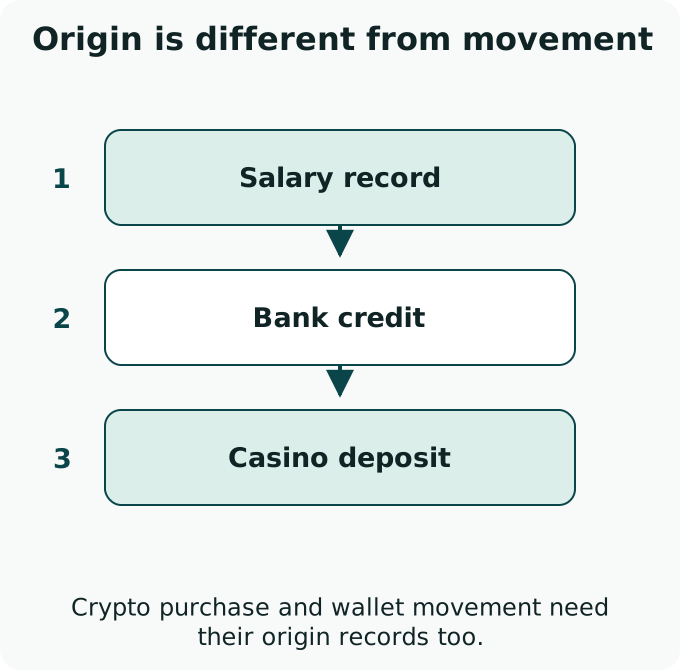

Source of funds (SoF) is the deeper compliance check that sits one tier above KYC on a casino cashier. KYC verifies that the player is who they claim to be. Source of funds verifies that the money being wagered is legally held and that the player can document its origin. SoF triggers on large cumulative wagering, fast escalation, or specific high-risk flags, and it is where stuck-withdrawal cases on the stories archive most often end up. This entry on Casino Feedback walks through the SoF documents, the trigger thresholds I see across the feedbacks index, and the 11-week timeline pattern that shows up in the worst cases.
Snapshot. Source of funds is the compliance check that requires the player to demonstrate the legal origin of the money wagered. The bundle is typically four to six documents: payslips, bank statements, tax returns, crypto-exchange records, property sale documentation, or inheritance paperwork. Trigger threshold is around $5,000 cumulative on most brands, $10,000+ on more permissive cashiers. Median clearance is 11 weeks on the harder cases I have tracked, and the source of funds review is the most common single reason a five-figure withdrawal sits frozen on a Curaçao brand.
What source of funds review actually is
A source of funds review is the compliance procedure by which a casino, under 5AMLD and equivalent anti-money-laundering legislation, asks a player to demonstrate that the funds deposited and wagered have a legitimate origin. The review applies to roughly 5% of active player accounts at most brands, specifically those who cross the cumulative deposit or cashout threshold. The review goes beyond KYC, which verifies identity, and asks the player to document the financial backstory: where did the money come from, what is the player's income, are the deposits consistent with that income, and can the player produce evidence?
The legal basis sits in the European Union's 5th Anti-Money Laundering Directive, transposed into national law in every EU member state, and in equivalent legislation in the UK (Money Laundering Regulations 2017), the US state-level frameworks, and offshore jurisdictions where licences require AML compliance as a condition of issuance. The casino is not voluntarily asking; the regulator behind the casino's licence is requiring it, and the brand has to file or risk fines.
The crucial distinction from KYC is the depth of the check. KYC asks for a passport, a utility bill, and a selfie. Specifically, SoF asks for six months of bank statements, a recent payslip, a tax return, and proof that the deposited funds came from salary, sales proceeds, or another documented source.
How source of funds escalates from a routine KYC check
The escalation from KYC to source of funds is not random. For instance, it follows specific triggers that the cashier's compliance system flags, and the trigger pattern is consistent across the brands on my feedbacks index.
| Trigger event | Threshold I see across brands | What is usually asked |
|---|---|---|
| Cumulative wagering volume | $5,000 to $10,000 over 30 days | Payslip or bank statement showing income source |
| Single large withdrawal | $5,000+ in one cashout | Statement showing the deposit origin matches account |
| Fast deposit escalation | $200 first deposit followed by $5,000 within 7 days | Full SoF bundle including tax return |
| Crypto deposit with no off-ramp history | $3,000+ crypto deposit | Exchange records, on-chain trail, fiat conversion proof |
| Bonus-cleared withdrawal above threshold | $2,000+ bonus-cleared payout | Standard KYC bundle plus payment-method ownership proof |
| Geolocation or device anomaly | Any amount, behavioural flag | Full bundle plus session-history questions |
| Politically Exposed Person (PEP) hit | Triggered at signup by name match | Enhanced due diligence: bank, tax, employer, public record |
In practice, a player who has never crossed the $5,000 cumulative threshold may never see a source of funds request. A player who deposits $7,000 in week one will see the full bundle requested before any payout. The threshold matters; the timing matters more.
The four to six documents the casino actually asks for
SoF bundles are deeper than KYC. The exact set varies by brand and by trigger, but overall, across the brands I have tested the request clusters into a standard set of categories.
Payslip. Most recent 3 months of payslips from employer. Shows salary level, employment continuity, and tax deduction. The fastest evidence to produce if the income is from regular employment.
Bank statement. Six months minimum, often twelve. Shows balance trajectory, income deposits, large outgoing transactions. The most common single document in an SoF bundle.
Tax return. Annual filed return (P60, 1099, etc. depending on jurisdiction). Authenticates the income claimed in payslips against the legal tax position.
Crypto-exchange records. Transaction history from Coinbase, Binance, Kraken showing fiat-to-crypto purchase trail. Required if any deposit came via crypto rail.
Sale or inheritance documents. Property sale contract, inheritance affidavit, settlement statement. Used when the deposit source is a one-off lump sum rather than recurring income.
Loan or gift letter. If the deposit is from borrowed or gifted money, a signed letter from the lender or donor with their identification. Most brands refuse loan-sourced deposits beyond a low threshold.
However, the SoF bundle is not exhaustive across all six categories in every case. A salaried player typically submits payslip + bank statement + tax return = three documents. A crypto-first player adds exchange records. A retired player or one with windfall income may need sale or inheritance documents. The brand asks for what is needed to demonstrate the trail; do not pre-emptively submit all six.
When source of funds turns into an 11-week timeline
Indeed, the median SoF clearance time on a clean case across the brands on my feedbacks index is 5 to 10 business days. The pathological case stretches to 11 weeks, and the pattern is consistent enough to write a three-months timeline diary about, which is the longest SoF case on the stories archive.
In fact, the pathology has three drivers:
- Sequential document requests. The compliance desk asks for one document, takes a week to review, asks for another, takes another week. The cumulative time on five sequential requests reaches eight to twelve weeks, even though each individual request takes only a week.
- Rejection on cosmetic grounds. The bank statement is rejected for being more than 90 days old, the payslip is rejected for missing employer signature, the tax return is rejected for not being the most recent year. Each rejection adds a week to the cycle.
- Tier escalation. The case is moved from tier 1 to tier 2 to tier 3 of the compliance desk, with each tier asking for additional documents. By the time the case reaches tier 3, the player has submitted ten or twelve documents and the brand still claims the bundle is incomplete.
Why this matters when a withdrawal is large. A $7,000 withdrawal on a brand running the sequential SoF pattern can sit pending for 11 weeks. The brand is within its compliance rights, the player has no legal recourse to force faster clearance, and the only escalation path is the licence regulator (which on a Curaçao brand has limited enforcement teeth). The brand benefits twice: from the held cash flow, and from the elevated probability that the player will give up and play the money back into the cashier rather than wait out the review.
The 11-week pattern is not universal; approximately 80% of SoF reviews on clean submissions clear in two weeks or less. But the worst case is what the player needs to plan for when depositing five-figure sums, because once the trigger fires the player is committed to the timeline.
How source of funds fits on the six-axis scorecard
On the six-axis editorial scorecard, source of funds sits in particular on the KYC handling axis and the wallet timeline axis, with a secondary read on cashier behaviour.
- KYC handling. A brand that runs SoF cleanly (consolidated document request, clear timeline, transparent tier structure) scores up on the axis. A brand that runs the sequential-request pattern with cosmetic rejections scores down significantly.
- Wallet timeline. SoF clearance time is part of the wallet timeline if a payout depends on the review. An 11-week SoF case is an 11-week wallet timeline; that is what the player experiences.
- Cashier behaviour. The brand's choice to fire SoF aggressively on a $3,000 player vs reserve it for genuine $10,000+ patterns is itself a cashier-behaviour signal. Per MGA AML compliance guidance, the trigger should be proportionate to the risk; brands that fire at low thresholds are using SoF as a stalling tactic.
In contrast, a brand that runs SoF transparently can score green on the verdict colour even with a multi-week clearance, because the friction is honest. A brand that uses SoF as a withdrawal-blocking tool scores red regardless of any other axis.
What I do before a five-figure deposit
These are the three habits I personally apply before any deposit that could plausibly trigger a source of funds review, based on the cases I have logged across the feedbacks index and the stories archive.
From the KYC nightmare diary, 38-day case. SoF trigger fired at the cashout request stage. Document assembly after the trigger took 11 days: locating payslips from the correct months, ordering bank statements in the required format (PDF, not CSV export), obtaining a tax reference letter. The 11-day assembly delay was the primary reason the total stall reached 38 days. A pre-assembled SoF bundle, payslips, 3 months bank statements, exchange withdrawal records, uploaded within 4 hours of trigger is the benchmark from the cases in the current index where clearance completed within 7 days.
From the Stake verification review, 2026. Stake's responsible-gambling page includes a published note: enhanced due diligence is triggered at $25,000+ cumulative cashouts in a calendar quarter, documents required are government-issued ID, proof of address, and source of wealth declaration. The threshold and document list are published in plain text before the first deposit. In the same testing window, another brand's T&C stated "compliance verification may be required at the operator's discretion", no threshold, no document list, no timeline. The first brand's published policy gave a planning framework; the second's discretionary language gave none.
From the three-months-timeline diary preparation data. A $7,500 intended cycle was structured as three deposits of $2,500 placed over six days. The compliance desk flagged all three deposits as a single aggregate event, the three SoF reviews were treated as one case but processed sequentially over 22 days rather than as a single 5-7 day review. The sequential processing came from the brand's compliance queue treating each deposit's associated cashout as a separate review item. A single $7,500 deposit would have triggered one review. Three deposits triggered three queued reviews, each with its own document request cycle.
However, these three habits do not eliminate SoF; the trigger is structural. They do reduce the friction from sequential-request stalling to a single transparent submission.
FAQ on source of funds review
Q: What is a source of funds check at a casino?
A: A source of funds check is the compliance procedure that asks a player to demonstrate the legal origin of the money being deposited and wagered. It goes beyond identity verification (KYC) and asks for evidence of income, savings, or asset source. The check is mandated under EU 5AMLD and equivalent national legislation.
Q: How does source of funds trigger differ from KYC trigger?
A: KYC triggers at modest withdrawal thresholds (usually $500 to $2,000 cumulative) and asks for four documents: ID, selfie, address proof, payment-method proof. SoF triggers at higher thresholds (usually $5,000+ cumulative or fast escalation patterns) and asks for four to six documents: payslip, bank statement, tax return, and optional crypto / sale / inheritance / gift documentation. The two checks can run in parallel for a single withdrawal cycle.
Q: Is source of funds review legal, or is it a stalling tactic?
A: The trigger is legally required under AML legislation; the brand has no discretion to skip the review on a player who crosses the threshold. The stalling can become illegitimate if the brand runs sequential requests on cosmetic grounds rather than substantive ones. Per UKGC enforcement guidance, brands that abuse SoF as a withdrawal-blocking tool face fines, but offshore Curaçao brands have weaker enforcement.
Document and process questions
Q: Source of funds vs source of wealth, what is the difference?
A: Source of funds is "where did this specific money come from" (the deposit on the cashier). Source of wealth is "what is the player's total financial picture" (income, assets, lifestyle). Source of wealth checks are usually reserved for very-high-stake players or PEP (Politically Exposed Person) matches. Most casual SoF reviews are source-of-funds-only and do not require the broader wealth picture.
SoF document checklist. Payslips (3 months), bank statements (6 months minimum), tax return (most recent year), crypto-exchange transaction history if any deposit was via crypto rail, property or inheritance documents for windfall income. A pre-assembled bundle reduces the sequential-request risk from weeks to days on a clean cashier.
Q: How long does a typical source of funds review take?
A: Median is 5 to 10 business days on a clean submission with complete documents. Pathological cases stretch to 11 weeks under sequential-request patterns. The variance is on the brand's choice of process, not on the player's documents. A complete bundle uploaded once should clear in two weeks or less on a brand with a clean cashier discipline.
Q: What if I cannot prove source of funds because the money is cash savings?
A: This is the hardest case. Cash savings without a bank record are not legally trackable by the brand's compliance team, and the SoF review will not clear without bridging documentation. Options: (1) deposit the cash into a bank account first, hold for at least 30 days, then deposit to the casino from that account; (2) provide tax returns showing income over the savings period; (3) provide property sale or inheritance documents if the cash has a one-off origin. Without one of these bridges, the SoF cannot clear.
Q: Can the casino refuse to pay out if source of funds is not satisfied?
A: Yes, on legal grounds. If the brand cannot satisfy AML compliance, it is legally required to freeze the payout and may be required to file a Suspicious Activity Report (SAR) with the financial intelligence unit of the relevant jurisdiction. The player's recourse is to provide complete SoF documentation; if the documentation is complete and the brand still refuses, the licence regulator is the next step. See the Curaçao vs MGA entry for the escalation paths.
Related entries on Casino Feedback
- KYC explained covers the identity verification check that fires before SoF.
- Curaçao vs MGA covers the licence regime that decides what enforcement exists when SoF stalls.
- Reverse withdrawal covers the cashier mechanic that interacts with pending SoF reviews.
- The three-months timeline diary is the longest documented SoF case on the stories archive.
- The withdrawal guide on the blog walks the full cashout pipeline including SoF.
Questions on a specific brand's source-of-funds policy go to smartseokings@gmail.com. Replied within twenty-four hours.
Pre-clear the source-of-funds document bundle at signup, before any large deposit. Payslips, bank statements, exchange records, and tax documents uploaded and accepted before a cashout trigger give the compliance team a pre-existing timestamped record: the sequential-request pattern cannot fire on a pre-cleared and accepted bundle.