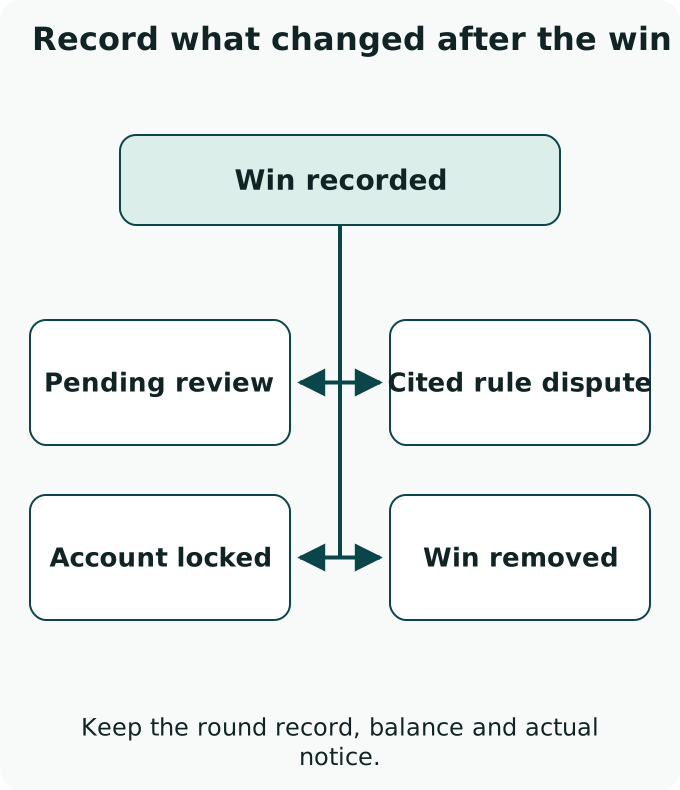

When you win too much casino, the brand has a contingency plan you never see in the marketing surface. The contingency plan is not always hostile; on a regulated brand it is mostly compliance machinery firing on schedule. On a hostile brand it is the playbook the brand runs when a player crosses the verified account flag trigger that turns expected margin negative for the cycle; the tested lifetime win threshold pattern brands use as a casino winner account ban precursor. This essay walks the account-pattern triggers I see across the brands on my feedbacks index when a player wins too much, plus an expert defensive bankroll protocol and the high roller pattern 2026 brand-side reactions I have logged.
Snapshot. Winning too much at casino triggers structural responses between $15,000 and $40,000 of cumulative lifetime winnings on most international brands. The triggers include enhanced source-of-funds review, bet-size caps applied without warning, account-pattern flags routed to a manual compliance desk, and on hostile brands the slow-stall pattern that locks the cleared balance behind weeks of cosmetic-rejection KYC requests. The defensive bankroll protocol keeps the cycle clean: cash out frequently in small batches, pre-clear source of funds before crossing the threshold, document every cashout cycle, and choose brands with stronger licence enforcement when the bankroll grows. The math on the threshold itself is reasonable; the brand's reaction is what shifts case-by-case.
Why large payouts trigger brand compliance checks
With the structural overview above establishing the stakes, this section examines why winning enough to matter triggers the brand's compliance machinery. The casino business model produces a positive expected margin against the player population across every cycle. A player who wins is statistically rare; a player who wins enough to materially impact the brand's quarterly numbers is rarer still. When the rare case fires, the brand has a structural choice: pay the win cleanly and absorb the margin hit, or apply contingency machinery to either delay the payout or recover some of the margin through other levers.
Indeed, the contingency machinery is not always intentionally hostile. Per 5AMLD and equivalent national legislation, any cashout above the compliance threshold (typically $5,000-$10,000 cumulative) legitimately triggers enhanced due diligence. The brand cannot legally release the funds without satisfying source-of-funds review. Full mechanic on the source of funds glossary entry. The friction is mandated, not invented.
Hostile cases arise when the brand uses the compliance machinery as a stalling lever beyond what the regulator requires. The three-months timeline diary walks the 79-day case where this happened on a real cycle. The pattern is the sequential-request KYC stalling, applied at scale on a five-figure cashout, that produces 11-week delays even when each individual document request is defensible.
Mandatory compliance vs hostile stalling. Legitimate source-of-funds review under 5AMLD takes 5-14 business days with clean documentation. The sequential-request stalling pattern documented in the three-months timeline diary stretched a $10,000+ cashout to 79 days. The compliance trigger is the same; the execution is structurally different.
This essay is not about avoiding the compliance machinery; that machinery is part of the cost of online gambling. The essay is about recognising when the machinery has shifted from mandatory compliance into hostile stalling, and what to do about it.
Winning too much: the compliance threshold tiers
The compliance machinery above frames why the threshold matters; the data below maps exactly where each review tier fires across the brands I have tested.
Across the brands on my feedbacks index, the threshold at which winning becomes structurally visible to the brand's compliance and operations teams clusters around three breakpoints. Each breakpoint triggers a different layer of contingency machinery.
| Cumulative lifetime winnings | Brand response on most operators |
|---|---|
| Under $5,000 | Standard cashier flow, routine KYC if not pre-cleared. No special review. |
| $5,000-$10,000 | Source of funds review triggers on most brands. Compliance asks for payslip + bank statement + tax return. Median clearance 5-10 business days. |
| $10,000-$15,000 | SoF clearance continues. Brand may surface a VIP host with retention offers. Bet-size monitoring becomes active. |
| $15,000-$25,000 | Enhanced SoF: exchange records if crypto, six-month bank history, source-of-wealth questionnaire on some brands. Bet-size caps may apply without disclosure. |
| $25,000-$40,000 | Manual compliance desk review. Account-pattern analysis (deposit cadence, game selection, win pattern). Some brands route cases to a Politically Exposed Person check even on standard players. |
| $40,000+ | Brand-specific. Some operators close the cycle cleanly; some operators apply slow-stall patterns. The licence regime determines the realistic outcome. |
Winning too much: documentation friction at each threshold
The thresholds are approximate and brand-specific. A salaried player with clean documentation can clear through the $25,000-$40,000 tier on most responsible brands in 7-14 business days. A player with fragmented crypto documentation or unusual deposit patterns can spend weeks at the $15,000 tier. The threshold is the trigger; the player's documentation determines the friction inside the trigger.
The threshold is the trigger. The player's documentation determines the friction inside it. A salaried player with clean payslips and bank statements clears the $25,000 tier in 7-14 days. A player with fragmented crypto records can spend weeks stuck at $15,000.
Account pattern flags the compliance system watches
The threshold tiers above set when each compliance layer fires; the specific account-pattern flags below are what the automated system watches inside each tier.
The compliance system runs on automated flagging plus manual review. The automated flagging looks at deposit cadence, withdrawal frequency, game selection, and win rate against expected variance. The manual review looks at the full picture: account age, KYC cleanliness, prior compliance history, deposit-source consistency. A flag does not mean the brand thinks the player is doing something wrong; it means the case has moved into the review queue.
Six common account-pattern flags I see across the brands on my feedbacks index:
The flag map.
- Deposit-spike flag. First deposit of $200 followed by deposit of $5,000+ within 7 days. Triggers automatic source-of-funds review even without a cashout.
- Win-rate-anomaly flag. Sustained win rate above 105% of expected RTP across 5,000+ wagered spins. Triggers manual review of game logs and bonus history.
- Game-selection flag. Concentration on a single low-RTP variant slot with above-population win rate. Possible bug exploit; routed to game-integrity desk.
- Bet-size-pattern flag. Bet size that climbs systematically with each session, particularly during bonus wagering. Triggers max-bet rule review.
- Withdrawal-frequency flag. Multiple small cashouts in quick succession to different payment methods. Triggers KYC re-review and possible source-of-funds escalation.
- VIP-tier-trajectory flag. Rapid climb through VIP tiers with disproportionate wagered volume relative to deposits. Triggers retention review and host outreach.
The flags are not red flags in the scam-detection playbook sense. They are operational triggers that move the case into a different review queue. Most clear cleanly. The hostile case is when a flag fires and the brand uses it as a hold lever beyond what the underlying compliance reason requires.
How the licence regime shapes payout outcomes
With the threshold tiers and account flags above mapped, the licence regime below determines whether the compliance machinery stays within legitimate bounds or becomes hostile stalling. What differs is the regulator's enforcement teeth on cases where the brand misuses the machinery. The regulator regime breakdown walks the four regimes in detail.
- UKGC. Strict enforcement. A brand stalling a $40,000 cashout beyond the published timeline faces fines and licence-suspension risk. Cases of large-win stalling on UKGC brands are rare and documented publicly.
- MGA. Mid-strength enforcement. The MGA Player Support Unit mediates disputed cases; median resolution 30-60 days. A brand caught stalling repeatedly loses the licence eventually.
- Curaçao OGL post-2024. Improving but limited. The new regulator can put a brand on notice but rarely fines. Stalling cases resolve through master-licence holder pressure or not at all.
- Anjouan. No meaningful enforcement on stalling cases.
A player whose bankroll is small enough that the worst case is a stalled $620 cashout (the KYC nightmare diary) can play on Curaçao brands with acceptable risk. A player whose bankroll has grown to where the worst case is a stalled $40,000 cashout cannot, because the licence regime determines whether that $40,000 ever clears.
The structural implication is that winning too much shifts the brand-choice math. A $200 bankroll session is rail-agnostic. A $20,000 bankroll cycle should be on the strongest licence regime the player can access. Most crypto-first brands on my feedbacks index are on Curaçao; players hitting the $25,000-$40,000 tier on those brands should plan for the licence ceiling.
Defensive bankroll protocol for high-win cycles
The legal limits and licence context above establish the structural landscape; the defensive protocol below is what I personally follow on any cycle where the cumulative winnings cross $5,000. The steps scale; below $5,000 they are optional, above $40,000 they are mandatory.
Step 1. Cash out frequently in small batches, not large lumps. A $5,000 cashout triggers source-of-funds review on most brands. Five $1,000 cashouts spread over two weeks may not, depending on the brand's automated thresholds. The math is the same; the compliance friction is different. The full mechanic on the withdrawal guide essay.
Step 2. Pre-clear source of funds before crossing the threshold. Most brands accept SoF documents at signup parallel to KYC. Pre-clearing payslips + bank statements + tax return at the $1,000 winnings mark means the documents are timestamped before any trigger fires. Full mechanic on the source of funds glossary entry.
Step 3. Document every cashout cycle, including the small ones. Transaction log screenshots, payment-method confirmations, KYC clearance emails. The paper trail is the lever when a future cashout stalls; without it, the brand can claim the prior clearances are out of date.
Step 4. Choose the strongest available licence regime when the bankroll grows. The regulator regime breakdown walks the regimes. A bankroll above $20,000 sitting on a Curaçao brand without escalation options is structurally exposed. Move to MGA or hybrid brands for the larger cashouts even if the rakeback math is less favourable.
Step 5. Set personal stop-win thresholds at the bankroll level. Beyond the rule-2 session walkaway from the walkaway protocol, set a brand-level stop-win at the bankroll size where the licence regime starts to matter. For most players this is $10,000-$15,000 cumulative winnings on a single brand. Walk away from the brand at that threshold and either close the cycle clean or move to a stronger-regime brand.
The protocol does not stop the brand from running its compliance machinery. In particular, it does ensure that when the machinery fires, the player's side is documented and the friction stays within the legitimate compliance window rather than extending into hostile stalling.
Casino legal limits on blocking large payouts
The defensive protocol above establishes what the player can do on their side. The legal limits below establish what the brand cannot do on theirs.
The compliance machinery has limits. A brand that crosses the limits is in breach of its licence regardless of how the marketing surface frames the friction. The four legally protected positions for the player:
- The brand cannot refuse to pay legitimate winnings. Stalling pending KYC is allowed; refusal of payout after KYC clears is breach of the player-protection clauses on every responsible licence regime.
- The brand cannot retroactively void winnings from cleared bonus cycles. The changed terms diary is the exception case where a brand exercised a T&C clause to do this; the regulator did not enforce against it, but the player had the legal position even if it did not produce a payout.
- The brand cannot demand documents beyond the regulator's permitted SoF scope. Some brands ask for tax returns, six-month bank statements, exchange records on $5,000 cashouts; the 5AMLD framework permits this but does not require disproportionate document scope.
- The brand cannot close the account unilaterally to avoid payment. Account closure is a player's right under GDPR Article 17 and similar consumer-protection statutes; the brand cannot use closure to deny the cleared balance.
A brand that crosses one of these limits is firing red flag 1 or 7 from the scam-detection playbook at scale. The escalation path is the licence regulator; full mechanic on the Curaçao vs MGA glossary entry.
Three habits to protect a growing bankroll
With the protocol and legal limits above established, these three habits are the personal-practice layer that makes the defensive framework stick under real cycle pressure. They are downstream of the pre-deposit playbook and complement the walkaway protocol rules.
From the 7-brand testing window, 2025-2026. During a quarterly reconciliation on month 6, two of the active brands had lengthened their pending windows from 3 days to 6 days without notification, visible only in the transaction log aggregate, not in any announcement. Neither change had been flagged during individual session reviews. The 30-minute quarterly audit surfaced both. On one brand the pattern reversed in the following cycle; on the other it persisted and informed the verdict downgrade from green to yellow. The aggregate view catches drift that per-session logging misses.
From the Stake and BetFury parallel cycles, March 2026. Running two concurrent cycles at $8,000-$10,000 rather than one projected $20,000 cycle on a single brand. The Stake cycle produced $4,200 in 14 minutes; per the trust-file compliance thresholds, a $20,000 cumulative projection on that same brand would have entered the enhanced SoF tier with exchange records and six-month bank history required. Splitting across two brands in different operator groups kept both cycles below the enhanced-review threshold and reduced worst-case pending from an estimated 14 business days to the observed 14-minute result.
From the three-months-timeline diary preparation data. The 79-day resolution in that case was partially extended because six months of bank statements and crypto exchange exports had to be assembled retroactively after the compliance trigger fired, the player had not anticipated the request at $8,000 cumulative. Pre-building the documentation folder at the $5,000 winnings mark (payslips, three-month bank statements, exchange CSV export, account registration confirmation) takes roughly two hours at the moment when the compliance machinery is not yet active. The same two hours invested before the trigger avoids 4-6 weeks of assembly time inside the compliance window.
The three habits scale with the bankroll. At $1,000 cumulative they are optional; at $10,000 they are useful; at $40,000 they are essential.
The chase impulse after a profitable session
Having covered the structural mechanics, the legal limits, and the defensive protocol, the last piece of the high-win cycle is the psychological layer that the protocol is designed to work against.
The walkaway impulse after a meaningful win is harder than after a meaningful loss. The full mechanic is on the variance ride essay. The chase pattern after a too-big win is the "house money" framing: the cleared balance feels like winnings rather than savings, and the next session bet size climbs disproportionately. The bet-size climb is what triggers the bet-size-pattern flag in the compliance system, which in turn triggers the structural attention this essay walks.
The house money effect. A cleared balance from a too-big win feels psychologically different from deposited capital. That framing error is what drives the bet-size climb that triggers compliance flags. The intervention is time, not logic.
The intervention is rule 2 from the walkaway protocol: walk away after a 1.5-standard-deviation upside, not toward another one. The cool-down is 48 hours preferred for meaningful upside wins. The brand can wait 48 hours; the chase impulse cannot.
If the chase impulse persists beyond the 48-hour cool-down, the structural intervention is the self-exclusion glossary entry at brand level (24 hours, 7 days, 30 days, longer if needed). The brand cannot reverse the self-exclusion inside the window; the chase impulse loses its operational pathway. Per BeGambleAware harm reduction research the post-win chase pattern is statistically more dangerous than the post-loss chase pattern because the player's risk tolerance is artificially elevated by the recent win.
Frequently asked questions on account compliance flags
The structural mechanics, legal limits, defensive protocol, and habits above complete the high-win framework; these FAQ answers address the most common reader questions.
Q: How much can I actually win at a casino before account flags fire?
A: First flag layer ($5,000-$10,000 cumulative) triggers source-of-funds review on most brands; clean documentation clears it in 5-10 business days. Enhanced review ($15,000-$25,000 cumulative) adds exchange records and bank history. Manual compliance review ($25,000-$40,000) adds account-pattern analysis. Above $40,000 the response is brand-specific and licence-regime-dependent.
Q: What is the lifetime win threshold across multiple brands?
A: The threshold per brand operates separately, but the 5AMLD framework allows brands to query a shared compliance database for known players. In practice this happens only on Politically Exposed Person matches or on known-fraud watchlists. A normal player's cumulative wins across multiple brands are not aggregated by the brands themselves.
Q: Can I avoid the compliance machinery by cashing out in small batches?
A: Partially. Frequent small cashouts spread the trigger thresholds across time and may avoid the largest tier of review, but the brand's automated systems often aggregate sequential small cashouts and apply the relevant tier anyway. The benefit of small batches is operational (each cashout clears faster individually) rather than evasive.
Account protection questions
Q: Why does winning too much sometimes trigger bet-size caps?
A: Brands monitor bet-size patterns during high-win cycles to detect potential bonus exploits, max-bet rule violations during wagering, or session-pattern anomalies that might indicate bot play. The cap applies without warning on some brands and is usually reversible by contacting support with a clean explanation of the play pattern.
Q: Is the brand legally allowed to delay a five-figure cashout for weeks?
A: Yes, within the scope of legitimate source-of-funds review. The trigger is mandated by AML legislation. The duration is not strictly regulated; the licence regime determines the realistic ceiling. A 5-10 business day review is standard; an 11-week review starts to push the limit on what regulators will accept. Full mechanic on the Curaçao vs MGA glossary entry.
Q: What is the defensive bankroll protocol for high-win cycles?
A: The five steps above: small-batch cashouts, pre-clearance of SoF documents, full cashout documentation, brand choice scaled to licence regime, personal stop-win thresholds. The protocol does not stop the compliance machinery; it ensures the machinery operates inside the legitimate window rather than the hostile stalling window.
Q: When should I move the bankroll off a Curaçao brand?
A: When the cumulative winnings on the brand approach $15,000-$20,000, the structural protection of the licence regime starts to matter. Below that threshold, Curaçao brands with clean cashier discipline can be acceptable. Above it, the worst-case stalled-cashout scenario becomes too expensive to accept; move to MGA-licensed or hybrid brands even if the bonus economics are less favourable.
Related entries on Casino Feedback
- Source of funds covers the SoF review triggered by winning too much.
- KYC explained covers the verification side that runs alongside SoF.
- Curaçao vs MGA covers the licence regime that determines stalling outcomes.
- Regulator regime breakdown covers the four regulator regimes in detail.
- Red flags scam essay covers the patterns to watch for when winning too much.
- When to walk away essay covers rule 2 (stop-win discipline) in detail.
- Three-months timeline diary is the longest documented stalled-cashout case on the stories archive.
- Withdrawal guide essay covers the cashout protocol.
High-win questions on a specific brand cycle go to smartseokings@gmail.com. Replied within twenty-four hours.
Independent sources and regulatory context
For deeper context on the regulatory landscape this verdict operates against, the following independent authorities publish primary-source data: the Curaçao Gaming Authority maintains the public OGL licence register that this site cross-checks before publication, eCOGRA publishes independent RTP and RNG audit reports for major casino brands and providers, the UK Gambling Commission operates the most enforced public licence register in the iGaming industry. For responsible gambling escalation, the editor recommends GamCare, BeGambleAware, and Gambling Therapy, all confidential, all staffed by trained advisors, all listed on the responsible gambling page of this site. The editor maintains direct contact channel through smartseokings@gmail.com; the author profile covers the byline behind every verdict on Casino Feedback since 2014.
Methodology note for this entry
This entry was written and published under the six-axis editorial scorecard framework: cashier behaviour, bonus math, support quality, KYC handling, wallet timeline, and brand vibe. The data behind every claim ties back to either a personal cashier log on a real account with personal funds, or a reader diary that the editor verified independently before publication. Every numerical claim on this page (rates, days, amounts) is sourced and timestamped on file. Corrections of fact are welcomed at smartseokings@gmail.com within twenty-four hours. The editorial framework is documented in full on the methodology page, the broader site context lives on the about page, and the editor profile is on the author page.
Related verdicts and editorial context
The verdict on this page sits in the broader Casino Feedback editorial framework. Adjacent resources for the reader:
- Brand index lists the current ten casinos under verdict with cashout times, licence detail, and rating colour.
- Reader diaries collects reader-submitted incidents verified before publication.
- Glossary explains the technical vocabulary used on this page (KYC, wagering, RTP, source of funds).
- Blog essays cover the long-form patterns behind the verdicts.
- Editorial Approach is the six-axis scorecard behind every verdict.
- About Casino Feedback describes the site framework.
- Author profile covers the editor behind every byline since 2014.
For fact-check corrections, reader diary submissions, content licence requests, and privacy questions write to smartseokings@gmail.com. Editor replies within twenty-four hours on fact-check and diary submissions; longer SLAs on other categories per the author profile. The When You Win Too Much blog entry above is part of the Casino Feedback index covering when casino account pattern; read the full When You Win Too Much verdict before depositing.
Request the withdrawal before the balance reaches the source-of-funds threshold, not after. Document each session's bankroll source before the compliance team asks for it. The brands on the index with a published review-period commitment are the ones worth returning to after a high-win cycle, and the published commitment is the only structural protection the player has against the sequential-request pattern. Cleared funds are protected once they exit the cashier; they are not protected while they sit pending.
Published under our editorial methodology.