
Glossary entry 4 min read · Apr 2026

KYC Casino Verification Explained: What Documents You Need 2026

See honest KYC explained: verified casino document bundle tested in 2026 on operators, Jumio integration, $500-$2,000 trigger thresholds.

Casino Feedback explainer on kyc explained

KYC (Know Your Customer) is the document check a casino runs against your account before it releases a withdrawal. It is also where the largest share of disputed cashouts get stuck. This entry explains what cashiers actually ask for, when the check fires, what to redact, and how to read the timeline so the check does not become a wall.

Snapshot. A standard KYC bundle is four documents (ID, selfie, address proof, payment proof). The check usually triggers between $500 and $2,000 of cumulative withdrawal, sooner if a bonus is involved. Median clearance in my testing window is 18 to 48 hours per resubmission; pathological cases stretch to multiple weeks. Most KYC pain is solvable by pre-clearance, not by lawyering up.

The four KYC documents almost every cashier asks for on kyc explained casino

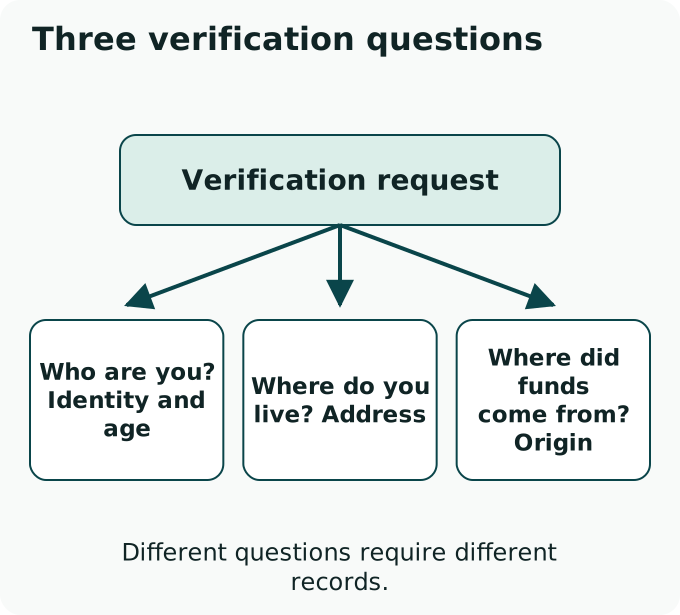
Across the brands on my current feedbacks index, the cashier requests cluster into four categories. The order may shift, the file format requirements may differ, but the four buckets are always the same.

Photo ID. Passport, national ID card, or driving licence. All four corners visible, every digit readable, no glare, no finger covering the document.

Selfie with ID. A photo of you holding the same document next to your face, with both visible in the same frame. Sometimes a video selfie is requested instead.

Proof of address. Utility bill, bank statement, or government letter dated within the last 90 days, with your full name and the address you registered with.

Payment proof. A screenshot or statement showing the payment method (card, bank account, crypto wallet) belongs to you, dated and matching the deposit history.

In short, the KYC bundle is the same whether you deposit $50 or $5,000. The difference is when the cashier asks for it.

When KYC verification actually triggers on a casino account on kyc explained casino

KYC is not always a sign-up step. On most brands the cashier collects documents lazily, when the cumulative withdrawal volume crosses a threshold or when a flag fires. The thresholds vary, but the pattern across my testing window is consistent.

TriggerTypical thresholdWhat is usually asked
First small withdrawal under thresholdUnder $500 cumulativeSometimes nothing; sometimes ID + selfie only
Cumulative withdrawal threshold$500 to $2,000 depending on the brandFull four-document bundle
Bonus-cleared withdrawalAny size once a deposit bonus was activeFull bundle plus an attestation form
High single withdrawal$2,000 or above in one cashoutFull bundle plus payment-method proof for the destination
Risk flag (geolocation mismatch, device change)Any amountFull bundle plus additional questions about the session
Source of funds check$10,000+ cumulative or rapid escalationBundle plus payslips, bank statements, crypto-exchange records

In practice, the last row is where KYC ends and source of funds begins. They are not the same check and the distinction matters when the cashier asks for "additional documents" without naming them.

KYC order of operations from upload to clearance on kyc explained casino

A standard KYC pass on a well-run cashier follows the same five phases. Knowing the order is what lets you read the queue position from a chat transcript without guessing.

  1. 1. Upload. Submit the four documents through the cashier's upload form (not by email). Confirm each file appears in the document list with a "pending" badge.

  2. 2. Automated check. A KYC provider (Jumio, Sumsub, Veriff, or Onfido depending on the brand) runs OCR on the ID, matches the selfie against the face on the ID, and validates the address against a third-party registry. This is usually under 15 minutes when no flag fires.

  3. 3. Manual review. If the automated check returns ambiguous, a human reviewer at the brand's compliance desk inspects the documents. The median manual review on the brands I have tested is 4 to 24 hours during business days, longer over weekends.

  4. 4. Clearance email. The brand sends a confirmation that the account is verified. Save this email. If a future withdrawal is challenged, this is the first piece of evidence the brand cannot ignore.

  5. 5. Withdrawal release. The pending withdrawal in the cashier moves from "verifying" to "processing" and is paid out according to the brand's published wallet timeline under its licence regime.

Indeed, if any phase stalls beyond the brand's published window, that is a cashier-behaviour data point worth logging.

Where casino KYC ends and source of funds begins

Specifically, KYC verifies that you are who you say you are. Source of funds (SoF) verifies that the money you are depositing is yours and legally yours. The two are linked but separate.

Why this matters. A brand asking for KYC documents is doing routine compliance. A brand asking for payslips, six months of bank statements, or a screenshot of your crypto-exchange withdrawal page has moved into SoF territory. SoF is legitimate under 5AMLD, but it is also where some brands escalate stalling tactics on large wins. If SoF is asked for and you did not expect it, request the specific regulatory ground in writing before you submit anything.

The dedicated source of funds entry covers the SoF side in detail. Within this KYC entry, the rule is: do not bundle SoF documents into KYC uploads without being asked specifically.

What I redact and what I leave readable on KYC documents

The cashier needs to verify the document, not to harvest every datapoint on it. Across the brands I have tested, the redactions that pass automated checks without rejection are:

  • Passport machine-readable zone. Leave the upper data fields (name, date of birth, document number) readable. The two-line MRZ at the bottom can be covered.
  • National ID card middle digits. The cashier needs the document number visible enough to OCR, but you can cover four of the middle digits with a finger or a black box in image-editing.
  • Bank statement. Show the bank logo, your name, the address line, the statement date. Black out every line item that is not relevant to the proof. The cashier does not need to see what you bought for groceries last Tuesday.
  • Crypto-wallet screenshot. Show the wallet address you withdrew to, the amount, and the timestamp. Black out the full balance and any other transaction lines.

What I do not redact: the full date of birth, the full name, the address, the document expiry date. Redacting any of those triggers a rejection on the automated check and adds 24 hours to the queue while a human reviewer asks for a clean resubmission.

How cashier behaviour leaks into the casino KYC queue

KYC clearance time is on the cashier-behaviour axis of my scorecard, not on a separate "KYC speed" axis. Therefore, a brand that runs a clean cashier also runs a clean KYC queue. A brand that stalls withdrawals stalls KYC the same way. The signal is the queue itself.

Cross-reference from real verdicts. The Stake verdict carries a median KYC clearance of 4 hours during my testing window, using a Jumio integration that pre-clears the bundle at signup. The Duel verdict carries a longer KYC pattern that fired on the second withdrawal cycle, when the brand asked for payment-method proof not flagged at signup. Both are Curaçao brands; the cashier behaviour is what differs.

Moreover, if KYC clearance on a brand takes more than 72 hours without a stated reason, that is a data point worth keeping. If it takes more than 72 hours with stalling tactics (asking for the same document twice, rejecting on cosmetic grounds, escalating to "tier 2" repeatedly), that is the pattern that sits behind the KYC nightmare diary on the stories archive.

FAQ on KYC casino clearance

The questions below are common reader questions from the editor inbox over the testing window.

Can I pre-clear KYC before I deposit?

On most brands, yes. The cashier accepts document uploads as soon as the account is created. Pre-clearing the four-document bundle before the first deposit means your first withdrawal moves through phase 1 (upload) and phase 4 (clearance email) without delay. The pre-clearance is also documented as the date the brand received your documents, which matters if the brand later argues "we never received those".

Why was my passport selfie rejected three times?

Three common causes. First, glare on the document obscuring digits. Second, the selfie hand covering part of the document. Third, the brand's KYC provider (Jumio, Sumsub, Veriff) requires the selfie to be a live video frame, not a still photo, and rejects every still by default. Read the rejection email carefully and resubmit only what was actually rejected.

Is it legal for a casino to hold my withdrawal for KYC?

Yes, under the EU 5th Anti-Money Laundering Directive and equivalents in other jurisdictions, the brand is legally required to verify identity before paying out larger sums. What is not legal is using KYC as a generic stalling tactic when the documents have already been submitted and the brand simply does not move. If that is happening, the licence regime determines what to do next; see the [curacao vs mga entry](/glossary/curacao-vs-mga/) for the escalation paths.

Document and timeline questions

What if I do not have a utility bill in my name?

Most brands accept a bank statement, a tax letter, a government correspondence, or an insurance policy as proof of address. Roommates and adult children living at home are the most common cases. Contact support before the cashier rejects the document; many brands have an off-form bypass when the standard options do not fit, and they will tell you what they accept if you ask first.

How long should KYC really take on a clean account?

From submission to clearance email, 18 to 48 hours is the median across the brands I have tested. Same-day clearance is common on crypto-first brands with a Jumio or Sumsub integration. Anything beyond 72 hours without a stated reason is a brand-behaviour signal to log on the cashier axis.

Can I see what data the casino holds on me after KYC?

Yes. Under [GDPR Article 15](https://gdpr-info.eu/art-15-gdpr/), you can request a copy of all personal data the brand holds, including the documents you submitted and any internal compliance notes attached to your account. The request must be answered within 30 days. The brand cannot charge for the request and cannot ask why.

Related entries on Casino Feedback

  • Curaçao vs MGA covers the licence regime that decides what happens if KYC stalls beyond reason.
  • Source of funds covers the deeper SoF check that sits one tier above KYC.
  • The withdrawal guide on the blog walks the full cashout pipeline end to end, KYC included.
  • The KYC nightmare diary is the longest stuck-KYC case on the stories archive.

KYC questions on a specific brand on the feedbacks index go to smartseokings@gmail.com. Replied within twenty-four hours.

Pre-clear the four-document bundle at account creation, before any deposit. The KYC clock starts at the first cashout request on most brands, pre-clearance moves that clock back to day one and removes the sequential-rejection risk entirely.