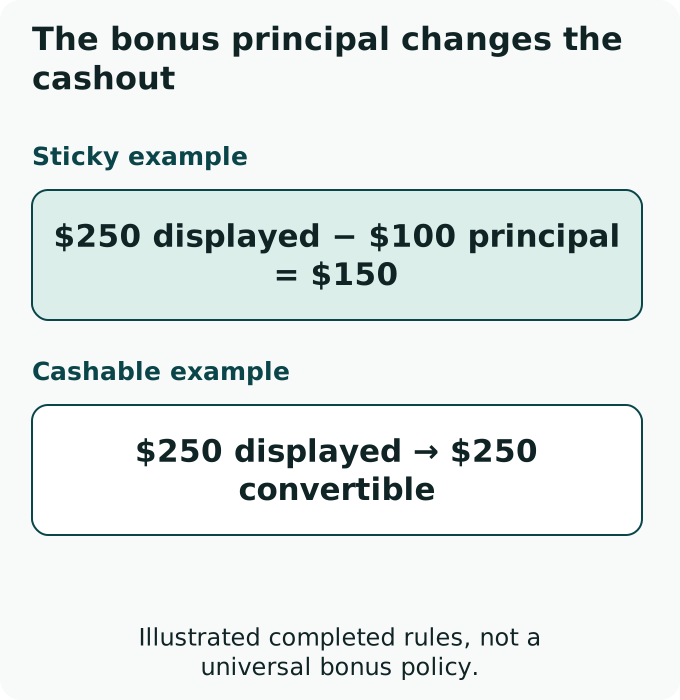

Sticky vs cashable bonus is the single most consequential distinction in casino bonus mechanics. A cashable bonus converts into withdrawable money the moment the wagering requirement is cleared. A sticky bonus stays attached to the cashier and is removed from the balance at withdrawal time, leaving the player with only the net winnings above the deposit and bonus. The two structures sit behind the same "100% up to $200" marketing headline and produce wildly different expected outcomes. This entry on Casino Feedback walks the mechanics, the math, and how the choice fits onto the six-axis editorial scorecard.
Snapshot. Cashable bonus: deposit + bonus → wagered → cleared → withdrawn at full balance. Sticky bonus: deposit + bonus → wagered → cleared → bonus stripped at withdrawal, only the deposit + winnings paid out. On a $200 base example with 40x wagering, the difference between a cashable and a sticky version is $200 on the withdrawal slip even when the wagering is identical. Across the brands on my feedbacks index, most welcome bonuses are sticky; the few that are cashable advertise it as a differentiator. The fine print is where the distinction lives.
What sticky vs cashable bonus actually means
Specifically, a casino bonus is "cashable" if the bonus money itself converts into withdrawable cash once the wagering requirement is satisfied. The player can withdraw the deposit plus the bonus plus any winnings, minus any explicit wagering deduction. A 100% match bonus that is cashable, on a $200 deposit, becomes $400 of withdrawable balance after wagering clears, assuming wins and losses net to zero across the wagering session.
A casino bonus is "sticky" (also called "non-cashable" or "phantom bonus") if the bonus amount remains attached to the cashier and is stripped from the balance at the moment of withdrawal. The player keeps the deposit and any winnings above the deposit plus bonus level, but the bonus itself disappears from the cashier slip. A 100% match sticky bonus, on a $200 deposit, returns the $200 deposit plus any winnings that exceed the original $400 starting balance.
In fact, the two structures share the same wagering math during the active phase. The divergence happens at the conversion step, and the marketing is usually designed to obscure which structure applies.
How a sticky bonus actually plays out on $200
The cleanest way to see the sticky vs cashable difference is to walk the same deposit cycle through both structures with the same wagering math. The walkthrough below uses round numbers for clarity.
The $200 base example. Cashable side.
- Deposit: $200
- Bonus (100% match): +$200
- Starting balance: $400
- Wagering requirement: 40x bonus = $8,000 wagered volume
- House edge on slots (4%): expected loss across $8,000 wagered = $320
- Expected ending balance after wagering: $400 - $320 = $80
- Cashable conversion: $80 withdrawable (deposit + bonus + winnings, minus expected loss)
The $200 base example. Sticky side.
- Deposit: $200
- Bonus (100% match, sticky): +$200
- Starting balance: $400
- Wagering requirement: 40x bonus = $8,000 wagered volume
- House edge on slots (4%): expected loss across $8,000 wagered = $320
- Expected ending balance after wagering: $80 cashier balance
- Sticky conversion: bonus $200 stripped at withdrawal. Player keeps only winnings above the $400 starting level. Since balance is $80 (below $400), payout = $80 - $200 sticky bonus = effectively $0. Player walks away with nothing despite running the full wagering cycle.
The arithmetic above is deliberately stark. In practice, variance can push the ending balance above $400, in which case the player keeps the excess on the sticky side. The expected outcome, though, is unambiguous: a sticky bonus on a 4% house edge slot is mathematically a $200 charity from the player to the brand on the typical wagering cycle.
When the sticky vs cashable distinction matters most
The distinction is biggest when three conditions combine: high wagering multiplier, low RTP slot eligibility, and large bonus relative to deposit. On a low-multiplier (10x) cashable bonus on a 97% RTP slot, the two structures converge because the expected loss is small. On a 40x sticky bonus on a 94% RTP slot, the difference is mathematically guaranteed.
| Variable | Cashable bonus impact | Sticky bonus impact |
|---|---|---|
| Wagering multiplier (40x vs 10x) | Higher multiplier increases expected loss but bonus still converts | Higher multiplier increases the gap between expected balance and starting balance, stripping more value |
| RTP of eligible slots (97% vs 94%) | Lower RTP increases expected loss but withdrawable retains some bonus value | Lower RTP usually drops balance below starting line; sticky bonus strips to net loss |
| Bonus size relative to deposit | Larger bonus increases withdrawable upside | Larger bonus increases the threshold the balance must exceed to net positive |
| Bonus expiry window (7 days vs 30 days) | Shorter window forces faster play but bonus value preserved | Shorter window forces variance to converge to expected loss, worst-case outcome |
| Game contribution coefficients | Lower-contribution games slow wagering but bonus structure unchanged | Lower-contribution games extend exposure to sticky stripping |
The honest reading: sticky bonuses are designed to capture the bonus value back to the brand on the expected-value path. The player keeps only the variance upside, and only if the variance turns positive within the wagering window.
How sticky vs cashable affects the six-axis scorecard
On the six-axis editorial scorecard the sticky vs cashable distinction lives on the bonus math axis with knock-on effects on brand vibe.
- Bonus math. A cashable bonus on a clean welcome cycle returns positive expected value to the player on a low-multiplier (under 25x) match. A sticky bonus on the same multiplier returns negative expected value. The deficit calculation on the verdict page accounts for the difference.
- Brand vibe. A brand that surfaces "this is a sticky bonus" in the bonus claim screen, with the conversion mechanics explained, scores up on brand vibe. A brand that prints "100% up to $200" without the sticky disclosure, requiring the player to dig through section 6.x of the T&C, scores down significantly.
Across the brands on my feedbacks index, the bonus math is the axis that splits green and red verdicts the most often. Sticky bonuses on hostile wagering math are the single largest contributor to bonus-math downgrades in my testing window.
The conversion step is where the two structures diverge. A cashable bonus converts into withdrawable funds at the wagering clearance moment: the player's $80 ending balance is $80 real money at the cashier. A sticky bonus holds the bonus component separately until withdrawal, then strips it from the cashier balance. The $80 ending balance on a sticky cycle delivers nothing after the $200 bonus is removed from the cashier slip. This is the expected outcome on the average wagering run, not a variance result. No bonus percentage figure in the marketing changes the conversion structure, and the conversion structure determines whether the player walks away with funds.
Cross-reference from real verdicts. The Stake verdict ships a cashable welcome match with a clearly stated multiplier and no sticky stripping at conversion. The Vavada verdict ships a hybrid where part of the bonus is cashable and part is sticky, disclosed in the bonus claim screen. The 1xSlots verdict ships a sticky welcome bonus disclosed only in the T&C, which is reflected in the bonus-math axis on its verdict page.
Three habits I keep around sticky vs cashable bonus
These are not generic checklist items. They are the three things I do personally on every new welcome cycle to determine which structure applies before clicking accept.
From the Fairspin welcome review, 2026. T&C Ctrl-F search for "stripped", "non-cashable", "phantom", "deducted at withdrawal": zero results. Section 4.4 read as: "bonus funds converted to real money upon wagering completion." Confirmed cashable structure: the bonus converts to real money and is withdrawable at wagering completion. The Ctrl-F check took 40 seconds. The opposite result, "non-cashable bonus funds will be deducted from the withdrawal amount", appeared in T&C of a different brand reviewed the same month; that brand's welcome offer was declined at that clause.
From the 1xSlots welcome math, March 2026. Expected balance calculation before depositing: (€100 deposit + €200 bonus) × (1 - 40 × 0.04) = €300 × (1 - 1.60) = €300 × -0.60 = -€180. The formula gives a negative expected balance, meaning the expected outcome is a full wager-out with no remaining balance. With a sticky structure, the bonus component is deducted at withdrawal regardless of remaining balance. The cashout outcome from a 40x sticky cycle: €0 bonus recovery + whatever deposit remainder survives wagering, statistical mean €120 on a 96% RTP slot at €300 base.
From the 1xSlots cycle decision, March 2026. 1xSlots welcome: sticky structure confirmed via T&C search ("bonus credited as non-cashable"), 40x multiplier on bonus + deposit base. Structural loss confirmed on pre-compute. Bonus declined at the accept screen; deposit of €100 placed without the offer. No wagering obligation. €700 USDT TRC20 cashout requested 3 days later, cleared in 26 minutes after Level 1 KYC. The reload promotion offered two weeks later was 20x on bonus only, a cashable structure at half the multiplier. The better offer appeared after the hostile welcome was declined, as expected.
The opt-out option exists on every brand. Welcome offers that vanish after the first deposit window are not lost forever; most brands re-offer through reload promotions, and the player who declines a hostile sticky welcome can usually catch a better promotion two weeks later.
Structure check, three-step. Step one: Ctrl-F the bonus T&C for "stripped", "non-cashable", "phantom", "deducted at withdrawal". Step two: if none of those appear, search for "bonus funds converted to real money": that phrase is the cashable confirmation. Step three: if the T&C is silent on conversion mechanics, ask support before clicking accept and save the reply in writing. These three steps take under two minutes and determine whether the bonus is worth accepting.
FAQ on sticky vs cashable bonus structures
Q: What is the difference between sticky and cashable bonus on a casino?
A: A cashable bonus converts into withdrawable money once the wagering requirement is met; the player can withdraw deposit + bonus + winnings. A sticky bonus stays attached to the cashier and is stripped at withdrawal, leaving only the deposit and any winnings above the original deposit-plus-bonus level. The two structures share the same wagering math but differ at the conversion step.
Q: How can I tell if a casino bonus is sticky or cashable?
A: Read the bonus T&C and look for the terms "stripped at withdrawal", "non-cashable", "phantom bonus", or "deducted from balance". These flag sticky structure. The marketing copy on the landing page rarely uses these terms; the structure is disclosed in section 6.x of the welcome bonus terms. If the T&C is ambiguous, ask support before clicking accept and save the answer in writing.
Q: Is a cashable bonus always better than a sticky bonus?
A: For the player, yes, on identical wagering math. The cashable structure pays out the bonus once the requirement is cleared; the sticky structure removes it. A 50% cashable bonus may still be better than a 100% sticky bonus on the same deposit, because the cashable converts and the sticky does not. The advertised match percentage is misleading on its own; the structure determines the actual value.
Comparison and strategy questions
Q: Sticky vs phantom bonus, are they the same thing?
A: Yes. "Phantom bonus" is an older industry term for what most brands now call "sticky" or "non-cashable" bonus. The mechanics are identical: the bonus contributes to wagering but does not convert to withdrawable money. Some brands use both terms in different sections of the T&C without distinguishing; treat them as equivalent.
Q: How much does the sticky structure typically cost the player?
A: On a 100% match sticky bonus with 40x wagering on a 96% RTP slot, the structural cost is approximately equal to the bonus amount. The player wagers through the bonus and ends with an expected balance close to the deposit alone; the sticky stripping removes the bonus from the cashier. On the $200 base example, the structural cost is approximately $200 over a full wagering cycle.
Q: Can the same casino offer both sticky and cashable bonuses?
A: Yes, and several do. The same brand may offer a sticky welcome bonus and a cashable reload bonus, or a hybrid where the welcome match is split (e.g. 50% cashable + 50% sticky). The structure is always specified in the individual promotion's T&C. Cross-promotion comparison within the same brand can reveal which structure the brand uses as a default and which as an exception.
Q: Does the wagering requirement apply differently on sticky vs cashable?
A: The wagering volume itself is calculated the same way: deposit + bonus times the multiplier, with eligible-game coefficients. The difference is in what happens after the wagering is cleared. The wagering math is identical; the cash-out math is structurally different. See the wagering requirements entry for the volume calculation in full.
Related entries on Casino Feedback
- Wagering requirements covers the volume math that runs the same way under both structures.
- Max bet rule covers the per-spin ceiling that applies during wagering on both structures.
- Rakeback explained covers the loyalty math that some brands offer as alternative to a sticky welcome bonus.
- VIP traps covers the higher-tier promotions where sticky structure becomes most common.
- The real cost of bonuses essay on the blog runs the full deficit math comparing both structures.
Questions on a specific brand's bonus structure go to smartseokings@gmail.com. Replied within twenty-four hours.
Compute the deficit and check the conversion structure before clicking Accept on any welcome offer. The sticky vs cashable distinction changes the withdrawal outcome at the end of the wagering cycle. A cashable bonus on a low multiplier can be a fair offer worth taking; a sticky bonus at 40x is the contract working against the player by design.