

Game maths
House edge: the expected cost of your wagers
House edge is the game's expected advantage over the player, expressed as a percentage of stakes. A game with 96% theoretical RTP has a 4% house edge under the same rules and assumptions.
At that rate, a fixed $1,000 of wagers has an expected loss of $40. That is an average from the game's mathematics, not a fee taken from your deposit or a prediction of your next session.
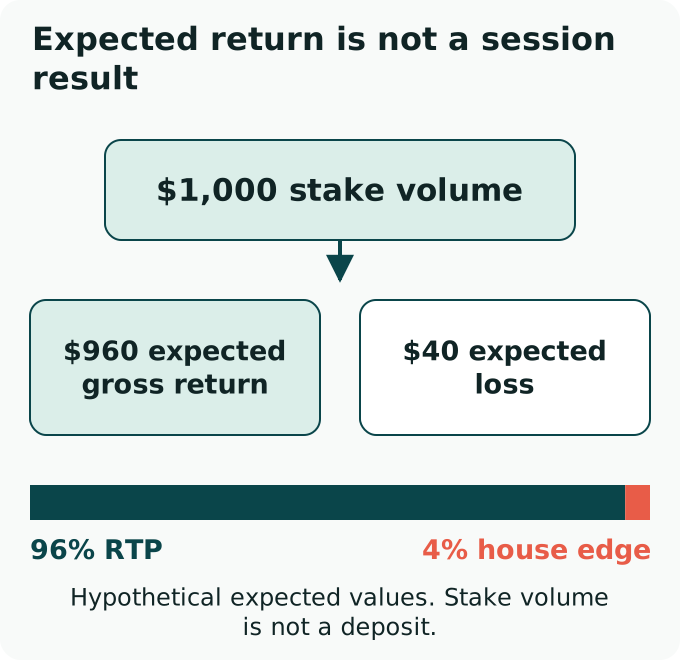
Two ways to express the same expectation
| Measure | Calculation | Meaning |
|---|---|---|
| RTP | $1,000 × 96% = $960 | Expected gross return from the stated stake volume |
| House edge | 100% − 96% = 4% | Expected loss as a percentage of stakes |
| Expected loss | $1,000 × 4% = $40 | The gap between stakes and expected gross return |
The calculation assumes the full $1,000 is wagered under the stated rules. It does not promise that an actual session returns $960.
Turnover can be larger than the deposit
Stakes include money wagered again. Suppose you place a $20 bet and it returns $30, including the original stake. If you then wager that $30, those two bets create $50 of turnover without a second deposit.
The percentage applies to all stakes placed, including stakes funded by earlier payouts. Using a $100 deposit as the stake volume would understate the theoretical cost if you kept reusing wins to place further bets. You could also run out before completing a planned amount of wagering.
A session does not collect the average evenly
A 4% edge does not mean each $1 round deducts four cents. A round follows its payout rules: it may return nothing, some of the stake or more than the stake. Actual results can finish above or below the expected value.
Two games can have the same expected loss rate and very different swings. Volatility describes the spread and size of returns. Hit frequency describes how often a paying result occurs; it does not establish that the payout exceeds the stake.
Use the edge that belongs to the rules you play
Does a lower house edge guarantee a longer session?
No. It lowers the expected loss per unit staked under comparable assumptions. Stake size, payout distribution and actual outcomes still affect how quickly a playing balance changes.
Does a run of losses remove the house edge from the next round?
No. In a game of independent rounds, previous results do not change the next round's probabilities or expected value. A losing run does not create a payment owed to the player.
Continue with the question that matters
- RTP vs hit frequency
Separate average return from the frequency of payouts.
- Volatility
Equal average returns can hide different payout swings.
- Game contribution
Bonus progress counts stakes differently from game returns.