
Glossary entry 4 min read · May 2026

Self Exclusion Casino 2026 - Verified Responsible Tool

See honest self exclusion casino: verified responsible tool tested in 2026 on operators, $0 cost, GamStop integration, 30-day cool-down plan.

Casino Feedback explainer on self exclusion

Self exclusion is the strongest single tool a casino player has when a pause is no longer enough. It locks the account against the player's own access for a chosen window, and on authority-level programmes it locks every brand in the regulator's jurisdiction at once. This entry on Casino Feedback explains how self exclusion works at the brand level and at the authority level, what the integration with GamStop actually does, and how I read a self-exclusion offering when I score a brand on the six-axis editorial scorecard.

Snapshot. Self exclusion at the casino cashier costs $0, locks the account for a chosen window between 24 hours and permanent, and cannot be reversed by the player or by support during the window. GamStop integration locks every UKGC-licensed brand with one signup. The strongest casino self-exclusion offerings have a 30-day cool-down between request and re-enable, a single-tap setup, and a confirmation email that documents the lock. The weakest hide the option behind two tiers of support and re-enable the account on demand the moment the window expires. Both are legal; only one is responsible.

What casino self exclusion actually is

Specifically, casino self exclusion is a player-initiated lock on a casino account that prevents login, deposit, and play for a defined period. It is the strongest single responsible-gambling tool, stronger than a deposit limit, stronger than a session-time alert, and stronger than a cool-off period. The lock is unilateral: once the brand applies it, neither the player nor the support team can reverse it inside the window. The mechanism is a permanent record on the account, which the cashier checks at every login attempt and blocks at the authentication layer.

Self exclusion sits at two levels:

  • Brand-side self exclusion is set inside one casino's cashier, applies only to that brand, and is the player's first lever when one specific operator has become a problem.
  • Authority-side self exclusion is run by a regulator and covers every brand licensed by that regulator with one signup. GamStop in the UK, BetBlocker cross-jurisdiction, and SPELPAUS in Sweden are the three programmes the responsible gambling page recommends.

In practice, the two levels are complementary, not redundant. A player with one stuck brand may need only the brand-side lock. A player with multiple accounts across multiple brands needs the authority-level signup, because the brand-side lock at one brand has no effect on the cashier at any other.

How a casino self exclusion request gets processed

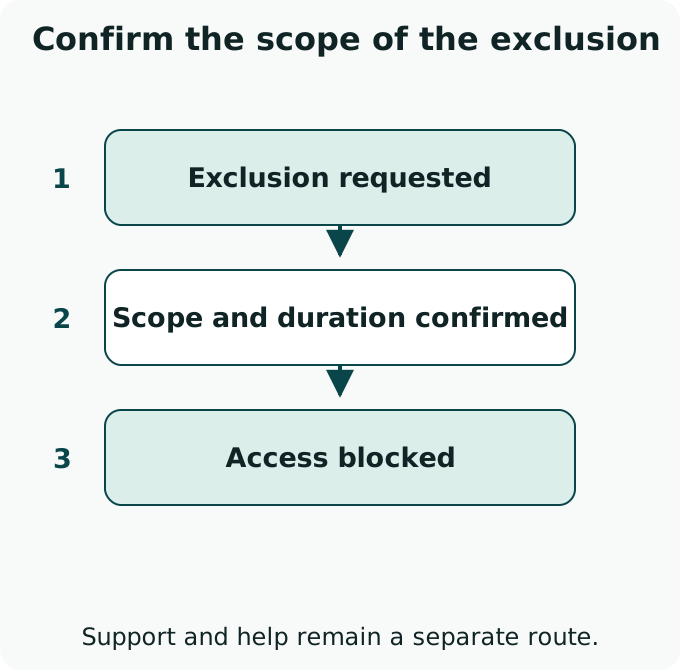
Brand-side self exclusion follows the same five-step flow across nearly every cashier on my feedbacks index. The user-facing UX differs in friction, but the underlying mechanic is universal.

  1. 1. Request initiation. The player opens the cashier or account settings, locates the responsible-gambling section, and selects "self exclusion" or "account closure for responsible gambling". On the most responsible brands this is a single click; on the worst it is buried three menus deep and routed through support chat.

  2. 2. Window selection. The player chooses a duration: 24 hours, 7 days, 30 days, 6 months, 12 months, 5 years, or permanent. The longer windows are usually irreversible inside the window even with regulator intervention.

  3. 3. Confirmation. The brand sends an email with the start time, end time, and the contractual statement that the lock cannot be reversed. Save this email; it is the only documentation that has legal weight if the brand later allows login during the window.

  4. 4. Lock applied at authentication. The brand's authentication layer flags the account. Any login attempt during the window returns a "account locked for responsible gambling" message. No deposit can be made, no play can occur, no promotional email may be sent (per UKGC guidance on excluded accounts).

  5. 5. Optional re-enable after window. When the window expires, the account does not auto-unlock on irresponsible brands; the player must explicitly request re-enable, ideally with a stated cool-off (24-72 hours) before access returns. Brands that auto-unlock the moment the window ends are doing the player a disservice.

Overall, the five-step flow takes 3-5 minutes on a clean cashier. Brands that require live-chat escalation for any of the steps are using friction as a deterrent, which is the wrong direction.

GamStop and authority-level self exclusion integration

GamStop is the UK Gambling Commission's authority-level self-exclusion programme. One signup at gamstop.co.uk locks every UKGC-licensed brand for the chosen window (6 months, 1 year, or 5 years). Therefore, the lock applies at the regulator's authentication layer; brands licensed under UKGC have no choice but to honour it, the brand's own cashier checks against the GamStop register at every account creation and every login.

Across the brands on my feedbacks index, none of the ten are UKGC-licensed, so GamStop does not directly apply. The crypto-first brands (Stake, Shuffle, BetFury, Duel, Gamdom) run on Curaçao or Anjouan and are outside the GamStop register. This is one of the structural risks of the offshore licence regime covered on the Curaçao vs MGA entry: no authority-level self-exclusion equivalent exists for Curaçao operators, so the player must rely entirely on brand-side self exclusion or on device-level blocking through BetBlocker.

The cross-border gap. A UK player who self-excludes through GamStop is locked out of every UKGC brand instantly. The same player, if registered at Stake (Curaçao), has to go to Stake's own cashier and request self exclusion separately. There is no authority-level register that covers the offshore market. This is why the responsible gambling page recommends combining GamStop + BetBlocker for full coverage: the regulator-level lock covers UK-licensed brands, the device-level lock covers everything else, and the brand-side lock covers the specific operator account that holds the deposit history.

For markets outside the UK, SPELPAUS covers Swedish brands licensed by Spelinspektionen, ROFUS covers Denmark, and the Spanish RGIAJ register covers Spain. There is no equivalent for international offshore brands, which is the gap players in non-licensed jurisdictions face.

When self exclusion is the right tool

Self exclusion is not the first responsible-gambling tool. The escalation ladder runs through deposit limits, session-time alerts, cool-off periods, and only then arrives at self exclusion. The responsible gambling page lists the signs to watch for; when two or more signs hold in the same week, self exclusion is the strongest single response.

SituationRight toolWhy
Single overspend session, no pattern yetDeposit limit + session-time alertPattern not yet established; lock is overkill
Two overspend sessions in same week24-hour to 7-day cool-off periodPause to break the immediate loop
Chasing losses across multiple sessions30-day to 6-month self exclusionRemoves the brand from the player's environment
Multiple brands, recurring patternAuthority-level (GamStop / SPELPAUS / BetBlocker)Brand-level lock leaks via other brands
Spending money intended for billsPermanent self exclusion + GamCare helplineCrossed into harm; clinical support needed

The choice between brand-side and authority-side depends on the breadth of the problem. A single brand can be locked with brand-side self exclusion in 3 to 5 minutes on a clean cashier, with the lock active before the next login attempt. Multi-brand patterns require authority-side or device-level coverage, because the brand-side lock at one operator has no effect on the cashier at any other brand in the regular rotation. The tool selection matters directly: a deposit limit at brand A does nothing to prevent a session at brand B; a GamStop registration blocks both simultaneously at the authentication layer for every UKGC-licensed brand without any per-brand registration step. For players outside UK-licensed jurisdictions, BetBlocker covers the device layer across all brands regardless of licence regime or country of registration, and it runs at the browser level rather than at the account level. The three layers combined (brand-side lock, authority register, device block) cover the full access chain and close every single-operator bypass.

The timing of a self exclusion request matters as much as the tool itself. Requesting the lock at the end of a losing session, under emotional pressure, tends to produce the shortest window chosen; the same player typically requests re-enable within 48 hours of the window expiring. The most effective self exclusion is set outside a session, at a neutral moment, with a window chosen for the pattern's severity rather than the session's emotion. A 30-day window set on a Tuesday afternoon with the cashier closed is structurally stronger than a 24-hour window set at 3 a.m. after a net loss. During the window, the concrete use of the time determines whether the return to play differs from the exit: the responsible gambling page lists the GamCare and Gambling Therapy lines, both of which run during the lock and offer structured support that the lock alone does not provide. Players who combine the lock with at least one clinical contact during the window report different re-entry behaviour than players who wait out the clock passively. The lock is a door; what the player does inside the closed room determines the outcome.

How self exclusion offering affects my six-axis scoring

Therefore, on the six-axis editorial scorecard self exclusion sits on the brand vibe axis. It is not its own axis because the offering interacts with broader cashier behaviour and support quality.

  • One-click access in cashier: strong brand-vibe signal. The brand surfaces the responsible-gambling tool at peer level with deposit and withdrawal.
  • Buried in support chat: weak signal. The brand has the tool because the licence demands it, but is using friction to deter use.
  • Documented confirmation email: strong signal. The brand creates a paper trail the player owns.
  • Re-enable with cool-off: strong signal. The brand respects the lock by adding 24-72 hours of cooling-off before re-enable.
  • Auto-unlock at window expiry: weak signal. The brand treats the lock as a contract, not a tool.
  • Self exclusion at signup walk-through: strongest signal. The brand surfaces the tool before any harm exists, normalising its use.

The three-layer configuration (brand-side lock, authority-level register, and device block) is the most reliable because each layer handles a different bypass vector. Brand-side handles the specific operator; authority register covers every brand under that regulator simultaneously; device block covers every brand regardless of licence regime. A player combining all three layers closes every access route that a single-brand exclusion leaves open.

Across the brands on my feedbacks index, the strongest self-exclusion offering I have tested is on a Curaçao brand that nonetheless ships a one-click toggle in the cashier with a 48-hour cool-off before re-enable. The licence regime did not force that choice; the brand did. That earns a brand-vibe upgrade independent of the other five axes.

A real self exclusion test on a brand from my index

The protocol I run on every new brand cycle is to test the self-exclusion mechanic before depositing more than a token amount. The test is simple: request a 24-hour exclusion, time the friction, document the confirmation, attempt login during the window, and note what happens when the window expires.

Test on a Curaçao brand from my testing window. Token deposit of $20. Opened the cashier responsible-gambling section. Self-exclusion toggle was present at peer level with deposit / withdrawal / KYC. Selected "24 hours" from the dropdown. Brand asked for one confirmation modal ("Are you sure? This will lock your account for 24 hours and cannot be reversed.") and applied the lock within 2 seconds. Confirmation email arrived within 3 minutes, with start time, end time, and the language "this lock cannot be reversed by support". Attempted login during the window: account locked, message displayed. Window expired: account did not auto-unlock. To re-enable, I had to submit a request through support, which added a stated 24-hour cool-off before unlock. Full cycle: 24 hours lock + 24 hours cool-off = 48 hours total. That is what responsible brand-side self exclusion looks like.

The same test on a different Curaçao brand returned a very different result: self-exclusion toggle was buried in the account settings page (three clicks deep), the confirmation email was generic with no end-time, and the window expired with auto-unlock and zero cool-off. Both brands are within the law. Only one is treating self exclusion as a real player-protection tool.

FAQ on casino self exclusion mechanics

Q: What does self exclusion mean at a casino?

A: Self exclusion is a player-initiated lock on the casino account that prevents login, deposit, and play for a chosen window between 24 hours and permanent. The lock is binding on both the player and the brand: neither can reverse it during the window, and the brand cannot send promotional email to a self-excluded account per UKGC guidance.

Q: How does GamStop self exclusion work across multiple casinos?

A: GamStop is the UK Gambling Commission's central register. One signup at the gamstop.co.uk site locks every UKGC-licensed brand for the chosen window. The brand's cashier checks against the GamStop register at every login attempt; if the player is on the register, the account is blocked at the authentication layer. The lock applies regardless of whether the player has an existing account or creates a new one during the window.

Q: Is self exclusion safe and confidential?

A: Yes. The lock is recorded only on the brand's compliance system and on the relevant authority register if applicable. Per GDPR Article 6(1)(c), the brand has a legal obligation to maintain the record but no permission to share it with employers, family, or third parties without consent. Authority-level registers (GamStop, SPELPAUS) operate under equivalent confidentiality.

Timing and re-entry questions

Q: Self exclusion vs cool-off period, what is the difference?

A: A cool-off period is a short pause (typically 24 hours to 7 days) that the player can request to break a session loop. The cool-off can usually be reversed by the player on request. In contrast, self exclusion is a longer lock (30 days, 6 months, 5 years, permanent) that cannot be reversed by the player or by support during the window. Use the cool-off for a single bad session; use self exclusion for a recurring pattern.

Quick reference. Brand-side self exclusion covers one casino. Authority-level programmes (GamStop for the UK, SPELPAUS for Sweden, BetBlocker cross-jurisdiction) cover every brand under that regulator with a single signup. If you have accounts at more than two casinos, start with the authority-level programme, then add brand-side locks for any offshore accounts outside the register.

Q: How much does self exclusion cost on a casino?

A: $0 on every brand on my feedbacks index and every regulated brand I have tested. Self exclusion is legally required to be free under UKGC consumer-protection regulation and the equivalent in other jurisdictions. If a brand asks for a fee to self-exclude, that is a serious compliance violation and worth reporting to the regulator named on the licence page.

Q: Can I un-self-exclude before the window expires?

A: No, not on a properly applied self exclusion. The lock is contractual and unilateral: neither the player nor the support team can override the window once it is set. Brands that allow reversal inside the window are doing a player-protection disservice and would fail regulator inspection. If you regret a self exclusion request immediately, you have to wait out the window; no exception.

Q: What happens to a deposit balance during self exclusion?

A: The balance remains in the cashier and is paid out at the player's request once the window ends, or via a direct withdrawal that the cashier processes during the window (the lock prevents play, not payout). Some brands allow during-window withdrawal of the existing balance to the verified payment method on file; some require the player to wait for window end. Read the brand's specific responsible-gambling page for the exact policy.

Related entries on Casino Feedback

  • Responsible gambling is the broader page that lists helplines and the full self-exclusion landscape.
  • KYC explained covers the verification side that interacts with self exclusion when a payout is requested during the lock.
  • Reverse withdrawal covers the cashier UI trap that self exclusion neutralises.
  • Curaçao vs MGA covers the licence regime that decides whether authority-level self exclusion applies.
  • The stories archive catalogues reader cases on self-exclusion experience.

Questions on a specific brand's self-exclusion policy go to smartseokings@gmail.com. Clinical questions about problem gambling are routed to the helplines listed on the responsible gambling page, not to the editor email.

Self-exclusion works only if it is applied at every brand in the regular rotation, not just the current one. A multi-operator exclusion through GamStop (for UKGC brands) or a direct request to each brand covers the full set. A single-brand exclusion leaves the player accessible at every other brand in the index.