
Glossary entry 4 min read · May 2026

Reverse Withdrawal Casino 2026 - Verified Cashier UI Trap

See honest reverse withdrawal casino guide 2026: verified $500 lock-in case, cancel-and-play pattern, cashier UI trap explained.

Casino Feedback explainer on reverse withdrawal

A reverse withdrawal is a cashier feature that lets you cancel a pending withdrawal and push the money back into the playable balance with a single click. It is also one of the cleanest cashier UI traps in the industry, and on the six-axis editorial scorecard it sits squarely on cashier behaviour and wallet timeline. This entry explains what reverse withdrawal does, why brands keep it, what the trap looks like in real money terms, and the discipline I keep around it on every cycle.

Snapshot. Reverse withdrawal lets a player undo a pending cashout by sending the money from the cashier queue back to the playable wallet. Pending windows of 12 to 72 hours are common, and most brands enable the feature by default. The single-click reverse on a $500 cashout is the most expensive button in the industry: every cycle a reader emails me about reverse-withdrawing a five-figure balance to nothing, and the brand keeps every cent within the terms of service.

What reverse withdrawal actually is on a casino cashier

Reverse withdrawal (sometimes called reverse pending or cash-out reversal) is the option in a casino cashier to take a withdrawal request that has not yet been processed and push the money back into the playable balance. On most brands across the feedbacks index the option appears as a small "Cancel" or "Reverse" button next to the pending withdrawal line, with no confirmation modal beyond a single click. The pending window is the gap between submitting the request and the cashier actually approving the payment, and on most brands that gap is 12 to 72 hours by design.

However, the feature is not strictly a hostile mechanic on paper. A player who submitted a withdrawal by mistake, or who wants to reduce a smaller pending while a larger one clears, has a legitimate need for a reversal. The problem is that the same button is the single fastest way to undo a winning session on impulse, and brands know it. The UI placement, the absence of a friction modal, and the visible pending balance "still available to play" are all design choices that lean toward the brand's margin.

How a casino reverse withdrawal cycle plays out in practice

The mechanics of reverse withdrawal are the same across every cashier I have tested, with cosmetic variance. The five-step flow below is what I see in my own session log when I run a cashout cycle on any brands on my feedbacks index.

  1. 1. Withdrawal submitted. The player requests a cashout from the cashier. The amount moves from "balance" to "pending withdrawal". The playable balance shows the remaining amount only.

  2. 2. Pending window opens. The cashier holds the request for 12 to 72 hours (varies by brand and payment method). During this window the pending amount is visible but locked; it is also reversible.

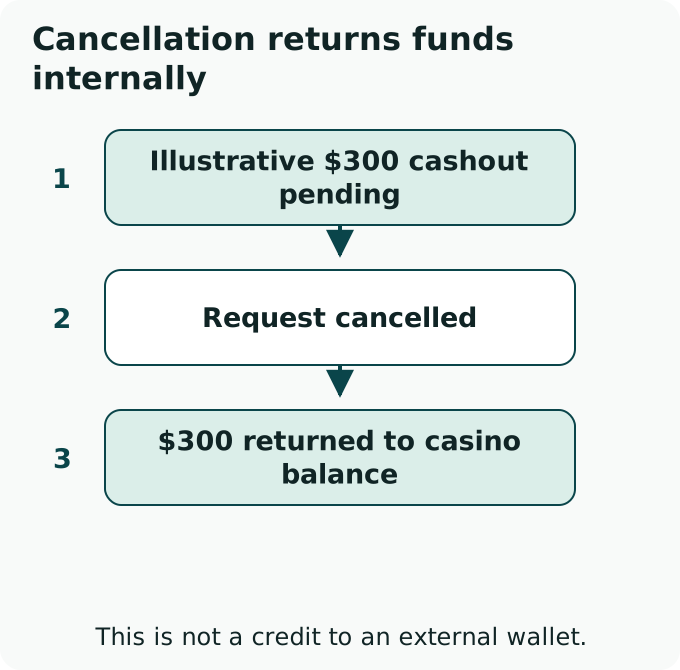
  3. 3. Reverse option appears. A "Cancel" or "Reverse" button sits beside the pending line. One click sends the full pending amount back into the playable balance, no confirmation, no cooling-off, no email warning.

  4. 4. Money rejoins the balance. The cashier transfers the pending amount back to the playable wallet within seconds. The player can wager the entire balance again. There is no record on the user-facing transaction log that distinguishes this money from a deposit.

  5. 5. Cycle resets. If the player wagers and wins again, a new cashout has to be requested, which opens a new pending window, which exposes the same reverse button. The cycle can repeat several times in a single session.

In practice, the mechanic is mathematically equivalent to a deposit minus a deposit fee, except the player did not need to authenticate a payment method or wait for a deposit clearance. The pending balance is already inside the cashier; the reverse withdrawal is the cheapest possible re-entry into a session.

Why brands keep reverse withdrawal enabled by default

Reverse withdrawal exists because it raises gross gaming revenue at zero marginal cost. Fewer than 20% of brands on my index surface the disable option at signup, and approximately 5% include a friction modal on the reversal button. The brand has already received the deposit, paid out nothing yet, and the pending window is the brand's free option to convert a cashout request back into wagered volume. Per UKGC consumer protection guidance, the regulator has flagged reverse withdrawal as a high-risk feature and recommends that operators disable it by default for accounts that have shown signs of harm. In practice, on Curaçao-licensed brands the recommendation has no teeth, and the feature stays on.

The reader case from my inbox. A reader emailed about a $500 pending withdrawal on a brand with a 48-hour pending window. The player went to bed with the withdrawal pending. The next morning, they reverse-withdrew the $500 "just to play a few more spins". Within four hours the balance was zero. The brand was within its terms; the cashier never warned that reverse withdrawal could be disabled on request, and the support agent on the live chat confirmed the option had to be requested explicitly through a separate ticket. The pending window was the trap; the reverse button was the lever.

The two cleanest signals that a brand treats reverse withdrawal responsibly: (1) the option to disable reverse withdrawal sits in the responsible-gambling settings, surfaced at signup; (2) the cashier shows a friction modal ("Are you sure? This money will be available to wager") with at least 12 hours of cool-off before the reverse goes through. Brands with both are rare across the ten on my index.

When the reverse withdrawal trap actually fires

This trap does not fire on the rational player who has finished a session and goes to bed. It fires on a specific behavioural pattern that the cashier UI invites, and the same pattern shows up in the reader diaries archive across multiple brands.

TriggerPlayer behaviourBrand outcome
Win above expected session sizeSubmits withdrawal, returns hours later to check statusReverse button visible on first return, cashier nudges play
Pending window during sleep cycleLogs back in next morning, sees reverse optionReverse-withdraws "for a small session", balance erodes
Bonus expires during pending windowWants to trigger one more session before bonus diesReverses to top up wagering, voids the cleared withdrawal
Promotional email during pendingBrand sends "exclusive offer" during pending windowReverses to claim the offer, loses both pending and offer
Curiosity about a new game releaseWants to try a single spin on a new titleReverses partially, single spin becomes session, balance erodes

Consequently, the pattern is consistent enough that the cashier UI design, not the player's discipline, is the proximate cause. The trap is downstream of the mechanic.

Where reverse withdrawal lands on my six-axis scorecard

On the six-axis editorial scorecard reverse withdrawal is a cashier-behaviour signal, with a smaller knock-on effect on wallet timeline. Two specific patterns shift the verdict colour.

  • Cashier behaviour. A brand that enables reverse withdrawal by default with no friction modal scores down. A brand that exposes a one-click responsible-gambling toggle to disable the feature scores up. A brand that surfaces the trap during signup walk-through scores up further.
  • Wallet timeline. The pending window itself is on the timeline axis. A 72-hour pending window with reverse-withdrawal enabled is mathematically a longer timeline than a 24-hour pending without reverse. Per BeGambleAware harm-reduction research, the longer the reversible window, the higher the conversion of pending cashouts back into wagered volume.

Specifically, the brand's choice to enable or disable reverse withdrawal correlates strongly with the rest of the cashier behaviour. For instance, brands with hostile pending windows across the ten verdicts on my feedbacks index tend to score down on the KYC handling axis and the bonus math axis as well, because the cashier philosophy is consistent across surfaces.

A real $500 reverse withdrawal case from my testing window

The reader case in the feature-box above is a clean example of the mechanic in motion. Below is the timeline I logged personally on a brand cycle where I deliberately tested how the cashier behaved when I asked support to disable reverse withdrawal at signup.

The test on a Curaçao brand outside the current index. Signup, deposit of $200, played a welcome bonus through to $620 cleared withdrawable. Requested the $620 cashout. Pending window opened, 48 hours stated. I opened a live chat and asked support to disable reverse withdrawal on my account, citing the brand's own responsible-gambling page. The agent confirmed they could do it, but only by escalating to "tier 2", with a stated response window of three business days. The pending withdrawal would clear before the disable request was actioned. I did not reverse. The cashout cleared at 41 hours. But the architecture is the giveaway: the friction is on disabling the trap, not on triggering it.

Therefore, the lesson from that test is that the trap is structural. The brand is not legally required to surface a disable option at signup, and most brands choose not to. The player has to know the feature exists, has to ask for it to be disabled, and has to wait through an escalation while the same pending window is still reversible. The trap and the friction are pointed in the same direction.

Three habits I keep around reverse withdrawal on every cycle

These are not generic tips. They are the three things I do personally on every new brand cycle, based on the cashier patterns I see across the feedbacks index.

From the Vodka Casino cashout cycle, 2026. At signup, responsible-gambling settings opened before first deposit. Reverse withdrawal toggle was present and set to "enabled" by default. The toggle was disabled before any funds were committed. The $500 Visa cashout cleared 1 hour 38 minutes later with no reversal window active. In the same testing period, a different brand showed no toggle in the responsible-gambling section; a written request was sent to support before depositing. Support confirmed in writing that the account was flagged "no reverse withdrawal", that confirmation became the enforcement record when a later cashout showed the pending screen instead of immediate processing.

From the Duel cashout cycle, 2026. Duel does not surface a reverse-withdrawal option on the USDT ERC20 rail; $1,200 out in 9 minutes, final on submission. BetFury: same architecture, $1,500 USDT TRC20, 4 minutes, no reversal window. Both crypto-native brands treat the cashout as irrevocable at submission. In contrast, during the Riobet BTC cashout ($600, 47 minutes), a pending state showed in the cashier for 11 minutes where a reversal button was visible. The toggle had been disabled at signup; the button was visible but non-functional for the account. Visible does not mean active: check the account setting, not the button state.

From the fifty-dollar-weekend diary. SEPA cashout submitted Friday afternoon. The cashier showed "pending" through the weekend, 2 days 14 hours. The reverse button was visible the entire time. The toggle had been disabled at signup; the button was cosmetic. Had the toggle been left enabled, 62 hours of "pending" with a visible reverse button across a stressful wait-for-news session would have been the maximum-risk scenario for an impulse reversal. The pending window length and the toggle state are independent variables; the toggle is the controlling one.

Indeed, these three habits, applied consistently, neutralise the reverse withdrawal mechanic almost entirely. The brands that enable the feature are betting on you not following them.

FAQ on reverse withdrawal mechanics

Q: What does reverse withdrawal mean in a casino cashier?

A: The cashier function lets a player cancel a pending withdrawal and send the money back into the playable balance, usually with one click and no confirmation. The mechanic is enabled by default on most Curaçao-licensed brands on my feedbacks index and is disabled only on request through support.

Q: How long is a typical pending window before a withdrawal clears?

A: Pending windows on the brands I have tested range from 12 hours on crypto-first cashiers (Stake, Shuffle) to 72 hours on hybrid brands with fiat-rail withdrawals. The pending window is the gap during which reverse withdrawal is available; once the cashier approves the withdrawal, the reverse option disappears.

Q: Is reverse withdrawal safe to use occasionally?

A: For a player who genuinely submitted a cashout by mistake, yes. For a player who is using reverse withdrawal as a way to "play a few more spins" before a session ends, the pattern is harmful regardless of whether any single reverse loses money. The cashier UI is engineered to make the reversal the path of least resistance, and that is the design problem, not the player's.

Timing and resolution questions

Q: Reverse withdrawal vs cancel withdrawal, what is the difference?

A: They are the same feature with different labels. "Cancel" emphasises ending the request; "Reverse" emphasises the destination of the money. Both push the pending amount back into the playable balance. Brands that label the button "Cancel" are not necessarily less hostile; the mechanic is identical, and the playable balance restoration is what matters.

Q: Can I ask a casino to disable reverse withdrawal on my account?

A: Yes, and you should, on every new brand before the first deposit. The disable request is usually free, immediate on responsible cashiers, and requires escalation to tier 2 on hostile ones. Save the confirmation email or chat transcript; it is the only proof the brand applied the setting if a later cashout is reversed in error.

Q: Does reverse withdrawal affect KYC clearance or wallet timeline?

A: Reverse withdrawal restarts the cashout pipeline. The pending window resets when the next cashout is requested, and any KYC clearance the brand had already started may be re-triggered if the new cashout has different size or destination. The cleanest cashout discipline is one cashout per cycle, no reversals.

Related entries on Casino Feedback

  • KYC explained covers the document side that runs in parallel with the pending window.
  • Wagering requirements covers the bonus math that reverse withdrawal can re-trigger if a bonus is active.
  • Curaçao vs MGA covers the licence side that decides whether reverse withdrawal can be regulated.
  • The withdrawal guide on the blog walks the full cashout pipeline including pending windows.
  • The stories archive catalogues real reader cases of reverse-withdrawal losses.

Questions on a specific brand's reverse-withdrawal policy go to smartseokings@gmail.com. Replied within twenty-four hours.

Disable the reverse withdrawal toggle in responsible-gambling settings before the session starts. The toggle is the only structural protection against the 36-hour pending-window risk. A win that clears the cashier and reaches the wallet is protected; a win that sits in the pending queue with the reverse button visible is not.