

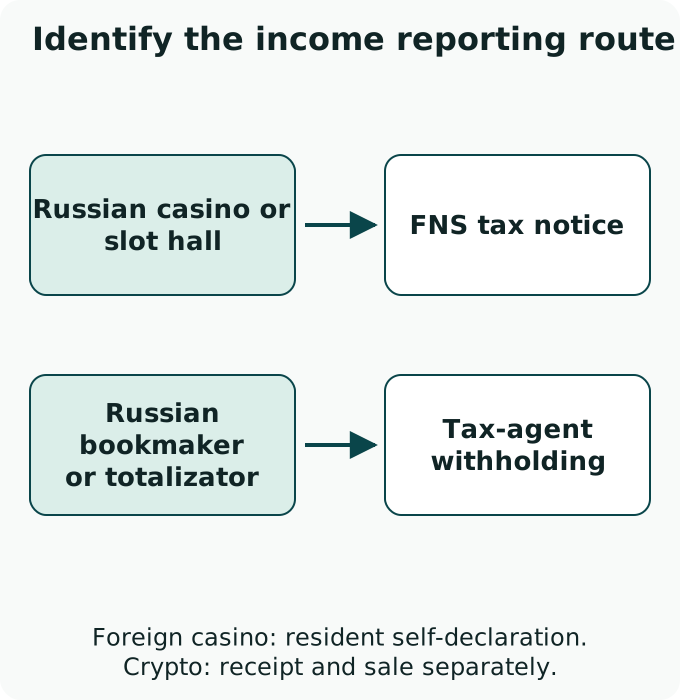
Russian land-based casino or slot hall
The Federal Tax Service, or FNS, calculates tax using the organizer's reported data and sends a tax notice. This particular income does not require your own 3-NDFL declaration.
Russia / Tax
Yes, casino winnings can create a Russian personal income tax obligation. A Russian land-based casino and a foreign online casino have different reporting routes. A Russian tax resident receiving foreign income generally calculates and declares it themselves; waiting for a casino tax notice can leave that obligation unmet.
Start with your tax residency, the legal entity paying you and the type of income. A withdrawal screen or a transfer labelled USDT does not settle those questions.
The Federal Tax Service, or FNS, calculates tax using the organizer's reported data and sends a tax notice. This particular income does not require your own 3-NDFL declaration.
The organizer acts as tax agent. For winnings received from 2026, the old RUB 15,000 withholding threshold no longer applies to this category.
For a Russian tax resident, foreign-source income generally belongs in the self-declaration route. Establish the taxable amount from records; do not assume the FNS receives the foreign site's account history.
Record the receipt and any later sale separately. The tax rules for selling digital currency do not, by themselves, determine how a foreign casino win is classified.
Under Tax Code Article 207, the general residency test is at least 183 calendar days in Russia during 12 consecutive months, with specific exceptions. Citizenship alone does not establish tax residency. Check your status for the relevant tax period, especially if you moved during the year.
Article 209 subjects Russian tax residents to tax on income from Russian and foreign sources. If you are not a Russian tax resident, the worldwide-income conclusion and resident rates below cannot simply be copied to your situation. The source of the income then becomes essential.
Article 214.7 sets a special annual calculation for Russian casinos and slot halls: the positive difference between money received from organizers and money paid to them in exchange for gaming tokens. The FNS uses organizer data supplied under Russia's cash-register rules.
For this category, the FNS calculates the tax after the year ends. Payment is due under the tax notice by 1 December of the following year, subject to the ordinary deadline rules. You do not submit a 3-NDFL declaration solely for that casino income. Check the calculation against your receipts and ask the FNS to correct discrepancies.
That reporting system does not establish that an overseas online casino submits the same data. It also does not create a universal rule allowing every online player to subtract all deposits from all withdrawals.
Article 228 generally requires a Russian tax resident to calculate and declare income from foreign sources themselves, unless a specific Tax Code exception applies. The annual 3-NDFL deadline is 30 April of the following year; payment is due by 15 July. Receiving no FNS notice does not remove this duty.
A payout can contain winnings and money you originally funded. Preserve the deposit, betting and withdrawal history so those amounts can be distinguished. A bank transfer alone may show who sent money without explaining what it represents. The amount to declare needs a supported income classification, not a guess based on your account balance.
Do not automatically deduct every losing bet, earlier year's losses, deposit or transfer fee. The Code provides particular calculations for particular gambling categories; it does not give a blanket deduction for an offshore account's lifetime losses.
Where the foreign payout's treatment is unclear, send the FNS a written question with the operator's legal entity and country, your tax residency, game type, dates and amounts, and the account ledger. Ask which income category applies, which documented amounts can reduce the base, and whether the winnings exemption applies. If payment was in crypto, include the asset and valuation records. Those details make the question answerable.
| Annual taxable amount in the group | Rate on this portion |
|---|---|
| Up to RUB 2.4 million | 13% |
| Over RUB 2.4 million up to RUB 5 million | 15% |
| Over RUB 5 million up to RUB 20 million | 18% |
| Over RUB 20 million up to RUB 50 million | 20% |
| Over RUB 50 million | 22% |
Each higher rate applies to the portion above its threshold. Crossing a band does not put the whole amount at that rate. Other income in the same group, including employment income, can affect where your winnings fall.
Suppose a casino pays you in USDT and you later sell it for rubles. Keep evidence of the original payout, its date, amount and ruble valuation, then the sale price, date and documented acquisition cost. A transaction hash identifies a transfer; the casino ledger explains why you received it.
Income from the sale or other disposal of digital currency has a separate tax-base group under Articles 210 and 224: 13% up to RUB 2.4 million and 15% above that threshold for residents. Do not apply the winnings table to that sale without checking the correct category and allowable documented costs.
The receipt of a foreign casino crypto win still needs its own classification. The sale rules do not establish that the original win is tax-free, that it is mining income, or that tax only matters when money reaches a bank. Keep the two events identifiable so the same history can support the calculation of each.
Save the operator's legal name, country and account terms. If a payment intermediary appears on the bank statement, retain evidence connecting it to the casino payout.
Export deposits, bets, wins, withdrawals and any tax withheld. Keep return of your own funds identifiable rather than labelling every incoming transfer as a win.
Record the original currency or crypto asset, amount, receipt date and the evidence used for ruble valuation. For crypto, keep transaction IDs and subsequent disposal records.
Retain travel-day records if residency is in doubt. For foreign income, work back from the declaration deadline; for a domestic casino notice, reconcile the organizer's figures with your receipts.
No. The 35% rule for certain promotional prizes is different from ordinary gambling winnings. If the payment is classified as gambling winnings under Articles 210 and 224, a Russian tax resident's taxable winnings fall within the relevant income group subject to the progressive 13% to 22% scale.
No. RUB 15,000 is not a general tax exemption. From 2026 the bookmaker and totalizator withholding rule no longer has that threshold; it remains relevant to the lottery reporting division. The annual RUB 4,000 winnings exemption is a different provision.
Do not rely on that. The domestic casino notice procedure uses specific organizer reports. Russian residents generally declare foreign-source income themselves under Article 228.
Paying tax addresses a tax obligation. It does not grant the operator permission to run gambling or settle a separate question about your role in its activity.
How ordinary play differs from organizing or helping an illegal gambling operation.
Identify the bank's stated restriction and the documents it is asking for.
Keep wallet ownership and transfer records clear.