

Russia / Player liability
Is playing an online casino a crime in Russia?
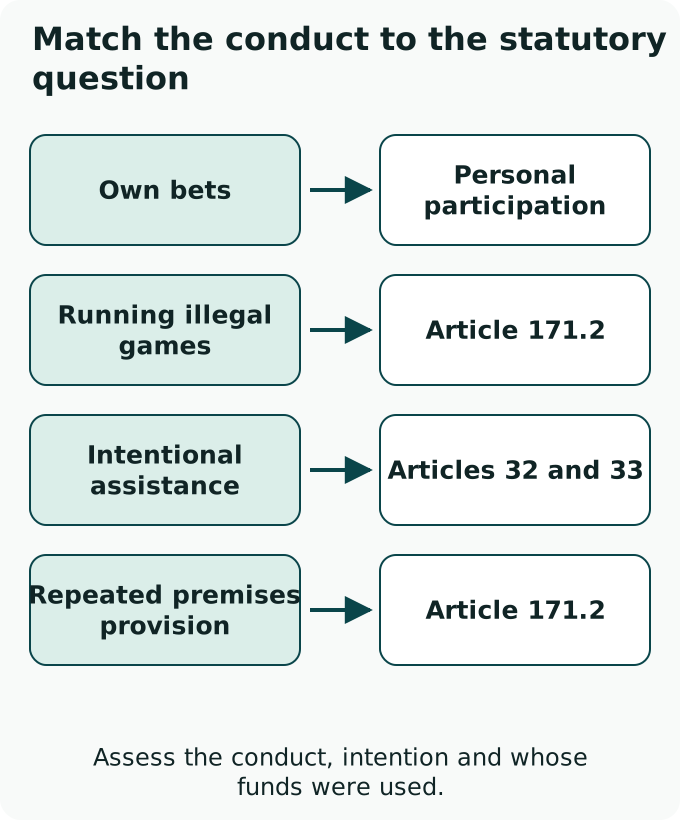
Placing your own casino bets with your own money does not, by itself, amount to the gambling offence in Criminal Code Article 171.2. That article targets illegal organization or conduct of gambling and systematic provision of premises for it. An ordinary player's role differs from running the operation.
The answer changes if you collect other players' money, run games for customers or intentionally help an illegal gambling business. Separate offences can also apply to conduct involving fraud or unlawful payment operations.
Your actual role is the important distinction
| What you do | What needs to be distinguished |
|---|---|
| Place your own bets in your own account with your own funds | Personal participation alone is not the organization or conduct of gambling criminalized by Article 171.2. |
| Set up a gambling venue, run games, recruit customers and take their payments | Operating or conducting illegal gambling can fall within Article 171.2. A small operation or a cashier role is not automatically outside its scope. |
| Intentionally help another person run an illegal operation | Complicity requires the facts addressed by Articles 32 and 33, including intentional joint participation. Ordinary betting is not automatically proof of that assistance. |
| Provide premises repeatedly or move other people's money for a fee | The premises provision is expressly addressed by Article 171.2. Payment activity can raise a separate question under Article 187; its specific conditions must be established. |
A foreign casino licence does not settle the Russian question
Federal Law 244-FZ, Article 5, prohibits organization and conduct of gambling through the Internet in Russia, with a specific exception for regulated interactive bookmaker and totalizator bets. That exception does not give an online casino the same permission.
The law also defines connections that bring online gambling activity within its Russian territorial scope. A player's residence in Russia is one of them. The operator being registered abroad does not, on its own, remove that connection.
The operator's prohibited activity and a player's criminal responsibility are separate questions. Article 171.2 identifies organization, conduct and systematic provision of premises. Its text does not create a standalone offence of merely placing your own casino bets.
When a player also works for the operation
A person may play games and also act as a cashier, arrange a room for customers or manage payments. The account label does not decide which role is being assessed. What they actually did, for whom and with what intention matters.
Article 32 defines complicity as intentional joint participation in an intentional crime. Article 33 covers organizers, instigators and aiders, including specified forms of intentional assistance. The fact that you placed a bet is not enough, by itself, to establish those additional elements.
Systematic provision of premises is expressly included in Article 171.2; its note defines systematic as more than twice. Before agreeing to supply a room or work in a gambling operation, have the actual arrangement assessed. The absence of a website in your name does not settle whether your duties amount to operating or assisting it.
Match the conduct to the statutory question
What the reported cases actually involved
In a 26 May 2026 report, the Kamchatka prosecutor described a trial involving rented premises, computers used for an Internet casino, finding customers and collecting their payments. The reported convictions concerned operating roles and also included a separate criminal-group charge. The report said the judgment had not yet entered into force. It was not a case described as prosecuting someone solely for their own bets.
A 25 August 2026 report from the Vladimir prosecutor concerned a charge against a person alleged to have repeatedly provided premises for illegal gambling. The report described an accusation, not a conviction, and said the accused denied guilt. It illustrates the premises-provider issue; it does not establish guilt or an offence of ordinary play.
Other people's money can create a different problem
An offer to receive funds from strangers, pass them on and keep a fee is different from paying your own stake. Article 187 now covers specified conduct involving payment instruments, account access and unlawful operations. The required facts vary with the provision; a transfer or a shared card is not automatically proof of an offence.
Keep the owner of the funds and the purpose of each payment identifiable. The law's definition of unlawful operations includes important conditions and an exclusion for consented operations using the customer's own money. Do not replace that analysis with a blanket claim that every borrowed card is criminal, or that every payment described as gambling is protected.
A bank's request for payout records or a restriction on card access does not, by itself, establish that you organized gambling. Obtain the bank's stated reason and handle that request as its own issue. If law enforcement contacts you about payments, the relevant documents and your procedural status need individual assessment.
If your role is being questioned, preserve the facts
Your own play
Save the account ownership details, deposits, bets and withdrawals that show whose funds were used and what the transfers represented.
Any work or arrangement
Keep messages, agreements and payment records concerning customer recruitment, collecting stakes, providing premises or handling funds. These facts matter more than a label such as player or helper.
The actual request
Keep the bank's written explanation or the law-enforcement document. Identify who is asking, what conduct they ask about and in what capacity you are being contacted.
Advice for an actual criminal matter
If you are asked about operating, assisting or handling other people's funds, take those records to a criminal defence lawyer. A general answer about personal bets cannot assess an additional role or a particular accusation.
Common points of confusion
Does using a VPN change a player's criminal role?
Changing the connection does not turn personal betting into operating a gambling business, or remove an operating role you actually have. It also does not grant the operator permission. Law 244-FZ uses connections other than an IP address, including Russian residence.
Does a large win alone make me an illegal gambling organizer?
No. Receiving a large personal win does not, by itself, establish organization or conduct of gambling under Article 171.2. The origin of the funds, any additional role and tax obligations remain separate questions.
Can I ignore tax because I was only a player?
No. The criminal-law distinction does not remove a tax obligation. A Russian tax resident's foreign casino income generally requires their own declaration analysis; it is not covered automatically by the domestic casino tax-notice procedure.
Is every activity around a casino immune because ordinary play is different?
No. Running games, intentionally assisting an illegal operation, systematically providing premises or committing a separate payment offence requires its own assessment. The ordinary-play answer applies to that ordinary-play fact pattern.
Continue with the question that matters
- Tax on casino winnings in Russia
Separate domestic notices, foreign income declarations and crypto disposal records.
- A bank card blocked after a casino payout
Work from the bank's stated restriction and document request.
- VPN access and casino account terms
Check what a connection change means for the account's location rules.
Last updated:Checked by: Karssen Avelar