Russia / wallet choices

Choose the wallet that can send the route you need

Start with the casino's exact coin and network, then choose how you want to hold it. A self-custody wallet gives you control of the keys and responsibility for recovery. A hosted service controls the transfer and can impose account, destination and payment-purpose restrictions.

On this page

Trust Wallet, MetaMask and Keeper offer self-custody tools, but their supported networks, platforms and fee handling differ. Altyn and Antarctic Wallet have separate service contracts; the word wallet does not make every balance freely sendable to a casino.

Decide who will control the transfer

ChoiceWho authorises the send?What you must handle
Self-custody appYour wallet signs with keys you controlRecovery, exact network, address checks and the fee resource
Exchange balanceThe exchange processes your withdrawal requestAccount eligibility, KYC, available networks, destination terms and withdrawal charges
Hosted payment walletThe provider processes operations under its service contractWhether that balance can be sent on-chain, to whom and for what purpose

A personal account at a service is different from a blockchain wallet whose signing keys you control. A casino's assigned deposit address is also controlled by the recipient.

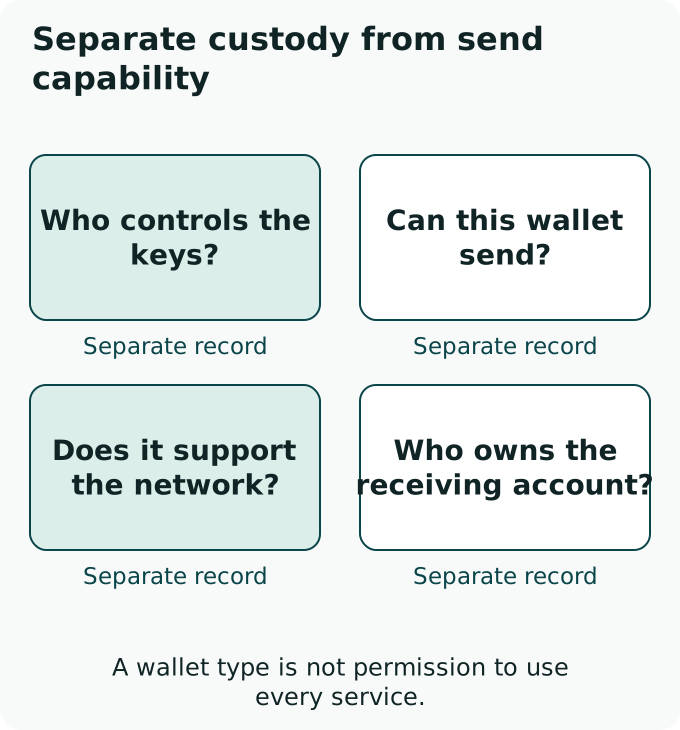
Wallet choice checks key custody, sending capability, network support and receiving-account ownership
A wallet type is not permission to use every service. This is an explanatory diagram, not an account screenshot.

Three apps to check against your actual route

Treat the following as capability choices. None establishes that a casino will accept the sender or that a built-in purchase provider will accept your Russian documents, bank or card. Check the version and platform you will use, then its actual receive and send screens.

Self-custody app differences

AppUseful capabilityCheck before funding
Trust WalletA multichain self-custody app with USDT and TRON supportSelect the supported asset on the required network; a USDT entry alone does not identify the chain
MetaMaskSupports Ethereum and now also native TRON accountsUse the matching account and network; review resources or TRX on the TRON send screen
Keeper, formerly TonkeeperMultichain support on mobile, including TON and TRON; Battery can cover supported transfer costsConfirm your platform has the required network and review the actual fee or Battery charge

Keeper's multichain rollout is mobile first. Do not assume an older Tonkeeper extension or desktop installation has the same capabilities.

A USDT balance does not always cover the next send

An ordinary Ethereum mainnet token transfer needs ETH for gas. TRON uses bandwidth and energy, with TRX paying when available resources do not cover the operation. Receiving USDT in a newly created TRON account does not, by itself, activate that account; check the wallet's genuine activation and fee instructions.

Keeper offers paid Battery support for certain TON and TRON transfers, including USDT on TRON. This can remove the need to hold the usual fee token for a supported send, but it does not remove the cost. Check the charge and balance before confirming.

You do not need to start staking, bridge an asset or sign a dApp transaction merely to make a normal address transfer. If your selected route needs an unfamiliar extra operation, stop and read the wallet's official instructions before funding it. Network and transfer fees explains the sender's cost and recipient amount.

What Altyn and Antarctic change about the choice

Altyn: a service ledger and broker route

Its electronic payment instrument is expressly different from a crypto wallet. Crypto funding and payouts must use wallets belonging to the user. Do not put a casino's deposit address into a form that requires your own wallet, or treat a named network in merchant documentation as proof of your retail account's available route.

Antarctic: hosted balances and payment features

Its terms describe external crypto withdrawals, so its QR features are not its only function. Those same terms prohibit gambling activities. It is therefore unsuitable as a casino funding recommendation; a personal wallet in the middle does not remove that restriction.

An exchange is still a provider

An approved account can have a matching withdrawal route but prohibit an intended destination or use. Check this before choosing a direct send or adding another transfer through your own wallet.

Check exchange conditions

Set up recovery before receiving money

  1. Use the genuine app

    Start from the wallet publisher's official download route. An advert, lookalike site or link sent by a stranger can install something else.

  2. Understand your recovery method

    Follow the setup method you actually chose. If it uses a recovery phrase, record it privately and keep it away from messages, shared screenshots and remote support. A local app password is not the same thing as a recovery phrase.

  3. Know the limit of support

    Someone with your recovery phrase or private key can control the funds. Support cannot make a lost self-custody secret harmless or reverse a completed transfer. Never send the secret for an account or deposit check.

  4. Preview a real send

    Check the coin, network, complete recipient address, extra memo field and fee. Use a small first transfer that still meets the recipient's net minimum, and wait for the actual credit before sending more.

Choose for the amount and task you actually have

For one transfer, a familiar app that supports the required route can be more useful than a complicated setup with unnecessary swaps. For longer-term storage, consider whether keeping keys on a daily-use phone matches your needs; a hardware wallet may separate signing from that device, but it still needs supported networks and a recoverable backup.

Keep the purchase receipt, the exchange withdrawal to your wallet and the onward transaction together. Using a self-custody wallet does not erase the source of the money. It adds a transfer that you may need to explain.


Wallet questions

Can I use one USDT address for every network?

Do not assume that. Use the address and network supplied for the exact transfer route. Even where two networks display the same address format, that does not mean the recipient credits both.

Does a free wallet mean free transfers?

No. An app can be free to install while the blockchain, a purchase provider or a supported fee-payment service charges for operations.

Does a wallet's Buy button prove it works with Russian cards?

No. The purchase can be supplied by a separate provider with its own identity, location and card conditions. Read the provider named in checkout before paying.

Last updated:Checked by: Karssen Avelar