

Crypto payments / networks and fees
The transfer fee and the amount received are different numbers
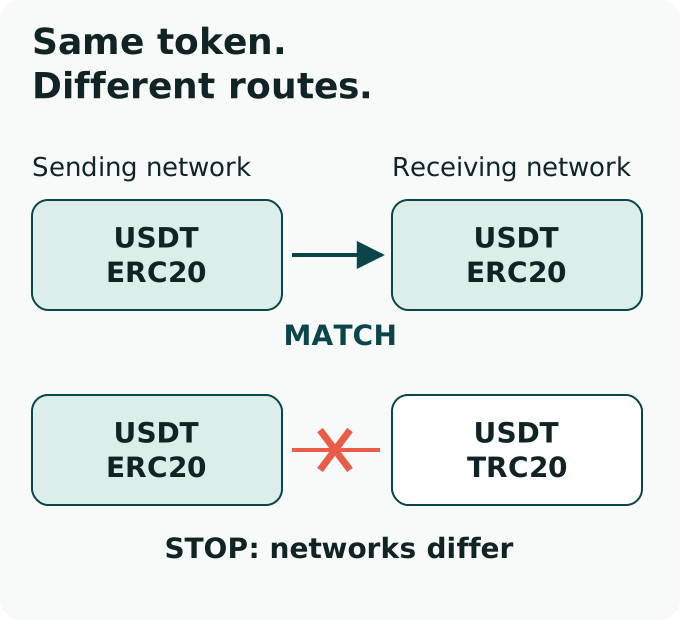
Choose a network supported for the same asset by both sender and receiver. Then compare the final fee and recipient amount. The cheapest network in a withdrawal menu is useless if the destination does not credit it.
A blockchain charges for a transaction; an exchange or payment service can set its own withdrawal or conversion charge. Those prices need not be equal. A fee can be deducted from the sent asset, paid separately in a native coin, or handled by a supported paid wallet feature.
The fee depends on the actual network
| Transfer route | Ordinary network cost | What to check in the sender |
|---|---|---|
| USDT on Ethereum mainnet | Gas paid in ETH for the token contract operation | ETH balance, estimated gas and the final quote |
| USDT on TRON | Bandwidth and energy; TRX can cover missing resources | Available resources or TRX, activation and any supported paid fee feature |
| USDT on TON | TON transaction costs; the native coin is now GRAM, formerly Toncoin | The wallet's fee or supported gasless/Battery charge, plus any recipient comment |
| Bitcoin on Bitcoin | A BTC fee influenced by transaction size and demand for block space | Fee rate, estimated total cost and confirmation target |
These are network mechanics, not universal exchange tariffs. Always use the coin and network names in the actual receiving instruction and sender preview.
A matching address format is not enough
Some networks use similar-looking addresses. Even an address that is valid on the selected blockchain can belong to a service that does not credit that asset on that chain. Match both the coin and network, not only the pasted characters.
USDT on Ethereum, TRON and TON follows separate transfer routes. A withdrawal labelled with one network does not become a different route because you paste another address. Check any required memo, tag or comment too; a receiver may use it to assign funds to an account.
TON is the blockchain name. Its native currency was renamed from Toncoin to GRAM in 2026; USDT on TON remains a separate token. A service may still show an older asset label. Follow its actual supported deposit instruction and ask the recipient about an unclear label before sending, rather than guessing from the name.
A 2 USDT fee can mean two different payments
| Fee treatment | Amount entered for the recipient | Total asset debited | Recipient receives |
|---|---|---|---|
| Deducted from 100 USDT entered | 100 USDT | 100 USDT | 98 USDT |
| Added to 100 USDT entered | 100 USDT | 102 USDT | 100 USDT |
If the recipient requires 100 USDT net, the first row falls short. Read the preview's recipient amount instead of relying on the number typed into the form. A separate fee-token charge must also be funded.
Ethereum gas is payment for work, not a percentage of USDT
Ethereum's transaction cost is gas used multiplied by the effective price per gas unit. One gwei is 0.000000001 ETH. The cost depends on the operation's work and the network's fee conditions; similar token transfers can cost similar amounts even when they move different sums.
For a calculation example, suppose an operation uses 50,000 gas at an effective 20 gwei per unit. The cost is 1,000,000 gwei, or 0.001 ETH. These inputs are hypothetical. They are not an estimate for your USDT transfer, and a wallet's gas limit is not the same thing as the gas eventually used.
A failed operation that is executed on-chain can still consume paid gas. An error before broadcast is a different event. Read the transaction result before retrying; repeated attempts can incur repeated costs.
TRON resources and wallet fee features change the preview
TRON uses bandwidth for transaction size and energy for smart-contract work such as a USDT transfer. If the sender lacks the necessary resources, TRX can be burned to cover the operation. The requirement can vary with the operation and account state, so a quoted TRC20 withdrawal fee is not a fixed law of the chain.
Some wallets handle costs through a paid feature. Keeper can use Battery for supported TON and TRON transfers, and its USDT-on-TRON support also offers other fee options. A send without buying the usual fee coin still has a cost; inspect the charge actually shown before confirmation.
An exchange withdrawal can deduct a set USDT charge while the exchange handles the network transaction. The sender's quote determines your debit and recipient amount. The fee shown in a blockchain explorer does not necessarily equal what the provider charged you.
Bitcoin fees depend on transaction size
Bitcoin fee rates are commonly expressed in satoshis per virtual byte. The number of inputs and outputs affects transaction size; network demand affects the rate needed for a chosen confirmation target. Two payments of different BTC amounts can have similar fees if their transaction sizes are similar.
Read the wallet's rate and total fee estimate together. A lower rate can mean a longer wait, and a casino may wait for its required confirmations before crediting. An exchange sets its own BTC withdrawal charge, which can differ from the transaction's network cost.
Add every transfer leg and provider charge
Buying on an exchange, withdrawing to your own wallet and sending onward can create a purchase cost and two separate transfer costs. Add conversion spreads, provider fees, network fees and any fee-token purchase you actually need. Do not add a second transfer purely because it looks like a way around a service's prohibited-use terms.
Altyn advertises a 1.5% stablecoin broker charge plus a selected network fee. That is a service charge, not Ethereum gas or a universal TRON tariff; its user-owned-wallet transfer conditions also apply.
Antarctic's FAQ lists inbound top-up charges of $2.75 for USDT on TRC20, 0.2 TON for its TON route and $0 for USDT on TON. Those are the FAQ's labels and inbound charges, not a promise of a zero-cost onward transfer. The service's terms prohibit gambling activities, so these figures should not be used to choose a casino funding route.
Read the last screen before confirming
Exact route
The sender and recipient offer the same coin on the same network, with the complete address and any required extra field.
Recipient amount
It meets the receiver's net minimum after all deductions on this leg.
Total debit and fee asset
You have enough of the sent asset and the required fee resource, native coin or supported paid charge.
Transfer record
Keep the preview, actual debit, recipient amount, network and transaction hash so you can distinguish a provider charge from an on-chain cost.
Continue with the question that matters
- The first crypto deposit workflow
From a supported cashier route to actual casino credit
- Wallet custody and fee handling
Choose an app that can make the required send
- Trace a deposit that has not been credited
Separate sender processing, blockchain state and account allocation
Last updated:Checked by: Karssen Avelar